01 · Direct answer.
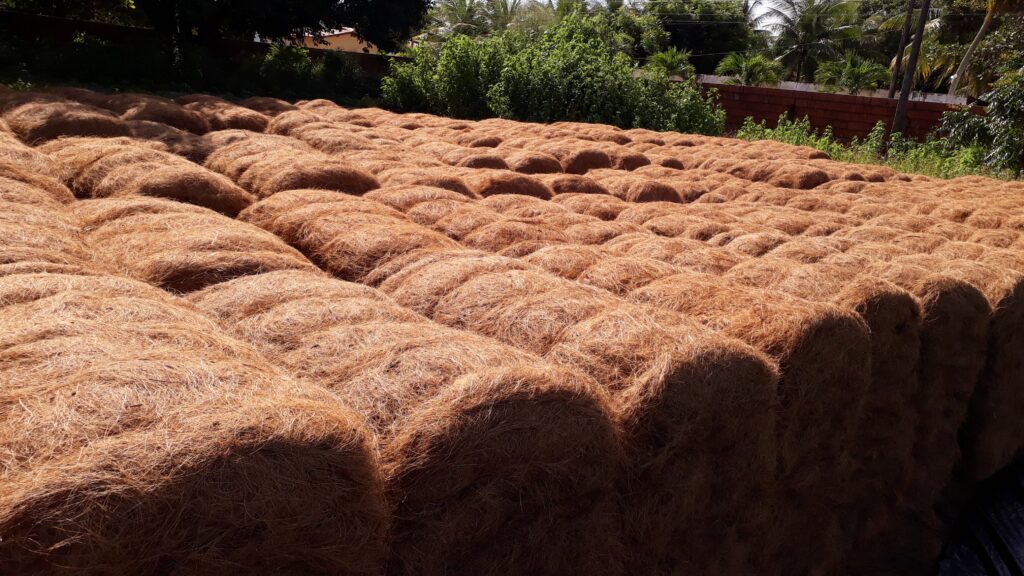
Coir fiber is the structural fraction of the dry coconut husk: fibers of 10 to 40 cm, with water holding of around 300 ml/L and the highest aeration in the line. As a growing medium it serves ornamentals, orchids, nurseries and substrate manufacturers, as the component that gives structure and drainage. As an industrial raw material it serves erosion-control blankets and geotextiles for slopes, molded pots, mattresses and composites. Carve sells it raw, uncombed, in pressed bales.[2]
| Family | Use | What the fiber does | Grade |
|---|---|---|---|
| Growing media | Ornamentals, orchids and nurseries | Aeration and drainage; substitute for tree-fern fiber | Washed |
| Growing media | Structural component in formulations | Macropores, resistance to compaction | Natural or Washed, EC ceiling in contract |
| Growing media | Landscaping, mulch, vegetated slopes | Cover, moisture retention, soil protection | Natural |
| Industrial | Blankets and geotextiles (needle-punched, latex-bonded) | Tensile strength, erosion control | Natural |
| Industrial | Molded pots, mattresses, composites | Raw material for needling, molding, pressing | Natural |
Applications as on Carve's Coir Fiber and Import Coir from Brazil pages.
02 · As a growing medium.
A Mexican coir substrate specialist separates coir's three particle sizes by function: pith holds water, chips drain, and fiber gives structure with moderate retention.[1] Fiber forms a network of strands through which water runs and air circulates, which is why it is the aeration component of a mix, not the retention component.
- Ornamentals and nurseries: structural substrate for ornamental pots, seedlings and nurseries, the main use of coir fiber as a growing medium in Brazil.[2]
- Orchids and epiphytes: drainage and root aeration; coir fiber is used as a substitute for tree-fern fiber (xaxim), whose extraction was banned in Brazil in 2001.[3]
- Drainage layer: fiber at the bottom of the pot prevents waterlogging in potted plants.[3]
- Structural component: aeration raw material for substrate manufacturers, in volume and specification under contract; see Coir for landscaping and nurseries.[2]
- Landscaping and mulch: loose fiber for covering beds and large pots, retaining moisture and protecting the soil; protection of vegetated slopes.[2]
- Retention: ~300 ml/L, the lowest in the line, against ~500 ml/L for coir pith; fiber alone dries quickly in a small pot and does not replace pith in crops that depend on water holding.[2]
03 · As an industrial raw material.
In industry, electrical conductivity is irrelevant; what counts is tensile strength, flexibility and uniform length.[4] The fiber is delivered raw and each manufacturer does its own carding, needling, latex bonding or molding.
- Blankets and geotextiles: needle-punched and latex-bonded biomats for erosion control, slopes and revegetation. Brazil's federal highway standard DNIT 074/2006 provides for coir fiber biomats to stabilise highway slopes; one tonne of fiber makes about 3,000 m² of blanket, according to manufacturers in the sector.[5] See also Coir fiber for geotextile biomats.
- Molded pots: biodegradable pots molded from coir fiber for landscaping and gardening.[2]
- Mattresses: needled coir fiber pads for inner layers of mattresses and upholstery.[3]
- Composites: natural-fiber laminates with polypropylene for door panels and automotive linings.[3]
- Lignin of 35 to 45 %: high resistance to decomposition, which underpins the durability of the fiber in blankets and in substrate.[2] In continuous cropping, medium-grade coir materials last 4 to 7 years, against 1.5 to 2 years for fine grade.[6]
04 · Specification and format.
| Parameter | Carve coir fiber | International trade convention |
|---|---|---|
| Length | 10-40 cm, uncut | Bristle fiber 10-30 cm; short mattress fiber 5-10 cm |
| Moisture | ≤ 18 % | Maximum 15 % for export bales |
| Water holding | ~300 ml/L | Not specified for industrial fiber |
| Total porosity | > 94 % | Not specified for industrial fiber |
| Lignin | 35-45 % | Not specified for industrial fiber |
| Loose density | ~55-80 kg/m³, actual value per lot | Hydraulically pressed bales, 100-125 kg, ~120×80×50 cm |
| Impurities and dust | Separation on a ~4.1 mm rotary screen | < 3-5 % for bristle fiber; < 10-12 % for short fiber |
| EC and pH | Measured per lot; Natural or Washed | Irrelevant in industrial use |
| Format | Bales of loose pressed fiber; weight and volume on request | 160-200 bales per 40' HC container, 18-22 t net |
Carve column: public data sheet on Coir Fiber. International column: coir fiber export specification briefing (source 7). Lead times and transport formats in Coir pith lead time and freight; company data on Company facts.
05 · What raw fiber does not do.
- It is not combed. It is not suited to making brooms, brushes or handicrafts, which need carded fiber graded by length.[2]
- It does not replace coir pith in crops that depend on water holding in a small pot.[2]
- It does not replace husk chips where dimensional stability over more than five years matters, as in blueberries and long-cycle roses; chips are covered on the Husk Chips page.[3]
- It is not cut to a fixed length; cutting, when needed, is done by the manufacturer.[2]
06 · Frequently asked questions.
Can coir fiber be used as a substrate on its own?
For ornamentals, orchids and nurseries that need maximum aeration and drainage, yes, and that is the main use of fiber as a growing medium in Brazil. For crops that depend on water holding in a small pot it does not replace coir pith: it holds about 300 ml/L against about 500 ml/L for coir pith, so it goes into mixes as a structural component.
Is Carve coir fiber suitable for brooms, brushes or handicrafts?
No. It is raw, uncombed fiber of 10 to 40 cm, a raw material for industrial processes that include their own carding, needling or molding. It is not suited to making brooms, brushes or handicrafts.
Why is coir fiber used in blankets for slopes?
Because the tensile strength of the fiber holds the blanket while vegetation establishes, and the high lignin content, 35 to 45 %, gives resistance to decomposition. Brazil's highway standard DNIT 074/2006 provides for coir fiber biomats to stabilise highway slopes; one tonne of fiber makes about 3,000 m² of biomat, according to manufacturers in the sector.
How is coir fiber sold and shipped?
Carve ships it in bales of loose fiber, pressed for transport, with weight and volume on request, Natural or Washed, with EC and pH measured per lot. In international trade the convention is hydraulically pressed bales of 100 to 125 kg, with maximum moisture of 15 % and about 160 to 200 bales per 40-foot container.
Do I need washed coir fiber for industrial use?
No. In blankets, geotextiles, molded pots, mattresses and composites electrical conductivity is irrelevant, because the material is not in prolonged contact with roots in a wet medium; the Natural grade is suitable. Washed fiber is recommended when the fiber goes into substrate for ornamentals, orchids and nurseries.
07 · Sources.
- Lic. David Cadena webinar (Mexico, hosted by Riego Rotoplas, 2026): coir's three particle sizes (chips, pith, fiber) and the function of each in a mix.
- Carve public data sheet, Coir Fiber: length 10-40 cm, moisture ≤18 %, water holding ~300 ml/L, porosity >94 %, lignin 35-45 %, density ~55-80 kg/m³, raw uncombed fiber, applications and bale format.
- Carve sector survey of coir fiber uses by segment (orchids and tree-fern substitution, drainage layer, needled mattress pads, natural-fiber and polypropylene automotive composites, limits of fiber against chips in long cycles), based on horticultural technical literature and manufacturers in the sector.
- Carve Applications page: technical criteria for industrial fiber (tensile strength, flexibility, uniformity) and irrelevance of EC in that use.
- DNIT, Standard 074/2006-ES: biomats for highway slope protection; approximate yield of 3,000 m² per tonne according to biomat manufacturers.
- Ing. Adalberto Romero webinar (Science Fetti / El Semillero, Colombia, 2025): durability by particle size (fine 1.5-2 years, medium 4-7 years, coarse 8-10 years).
- Coir fiber export specification industry briefing (2026): bristle fiber 10-30 cm, short fiber 5-10 cm, maximum moisture 15 %, impurities <3-5 % (bristle) and <10-12 % (short), bales of 100-125 kg and ~120×80×50 cm, 160-200 bales and 18-22 t per 40' HC container.