Coco peat blocks, coir mix, coir fiber and husk chips from Brazil.
Low-EC coco peat, washed or buffered, made from dry coconut husk that is not retted. 5 kg blocks, bales or bags, 22 pallets per 40' container, every lot measured. Shipped from Pecém, the Brazilian port closest to Europe and the US East Coast, on a route that does not pass through the Suez Canal.
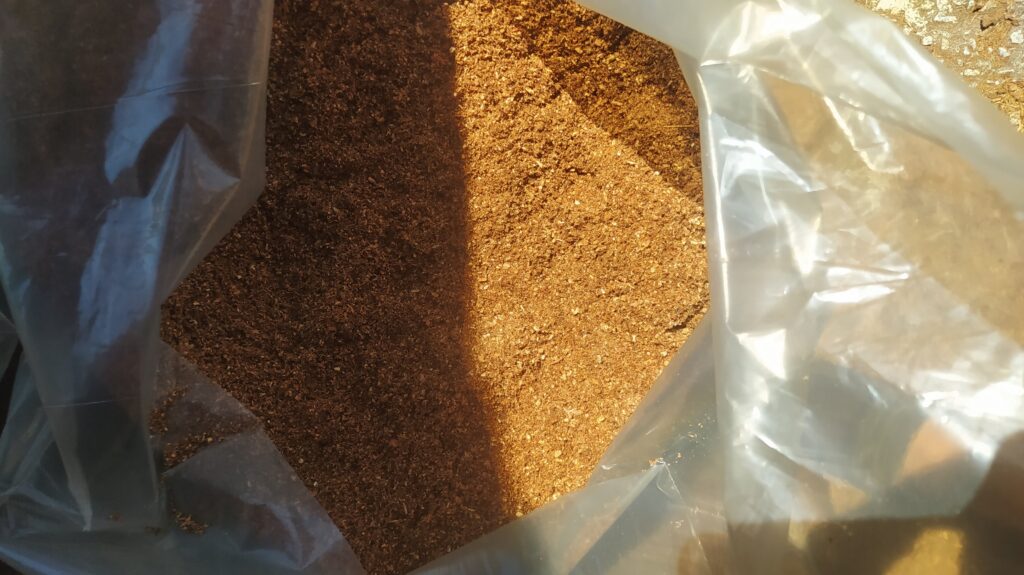
Four products, one husk.
All four come from mature dry coconut husk processed mechanically, without chemicals. Formats and grades below are the ones we ship; the quotation is per 40' high-cube container.
Main product- Grades
- Natural · Washed EC < 0.7 · Buffered EC < 0.5 mS/cm
- Formats
- 5 kg block 30×30×14 cm (≥ 65 L) · 100 L bags · compressed bales
- Uses
- Grow bags and slabs, potting mixes, nursery trays, berries, tomato, pepper
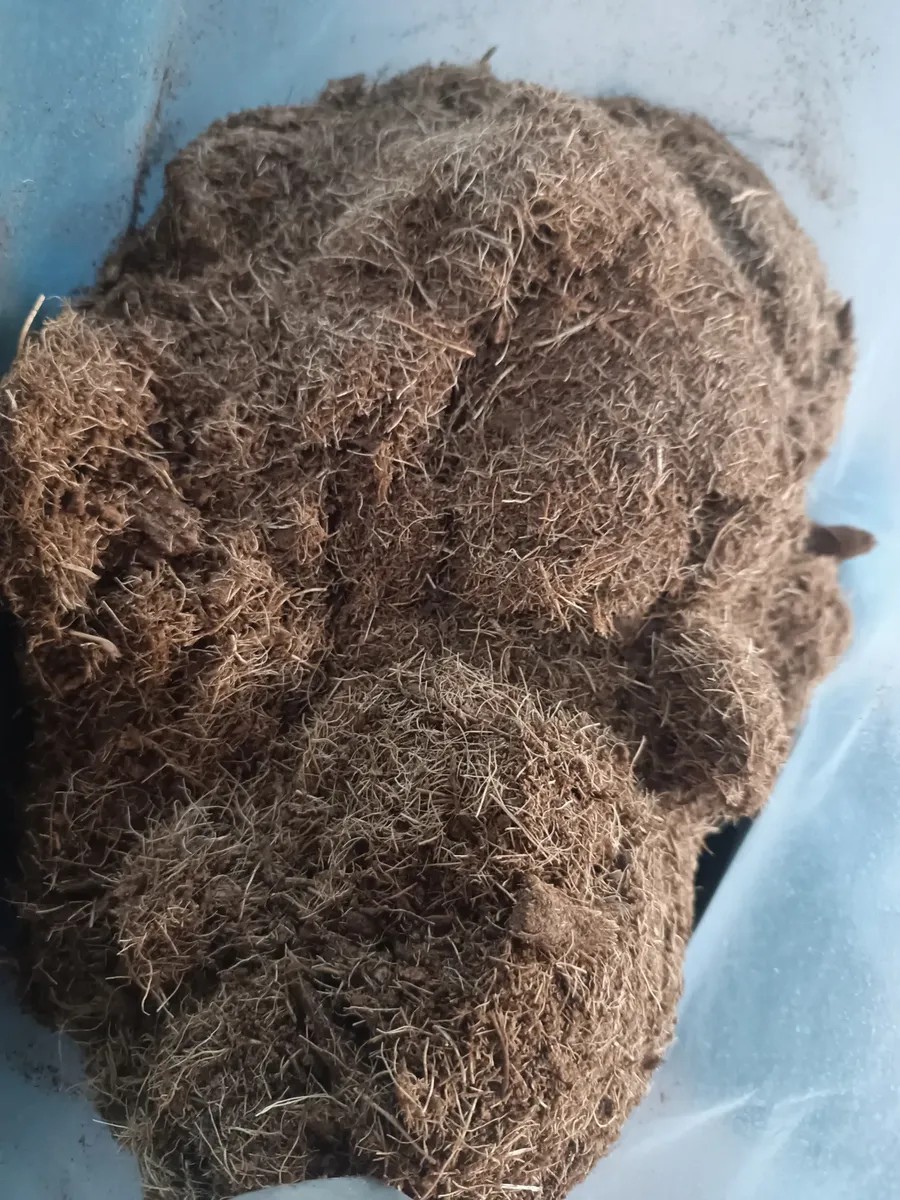
- Grades
- Natural or washed; ratio of pith to fiber defined with the buyer
- Formats
- 100 L bags · compressed bales
- Uses
- Potting mixes, containers, landscaping, substrate manufacturers' own blends
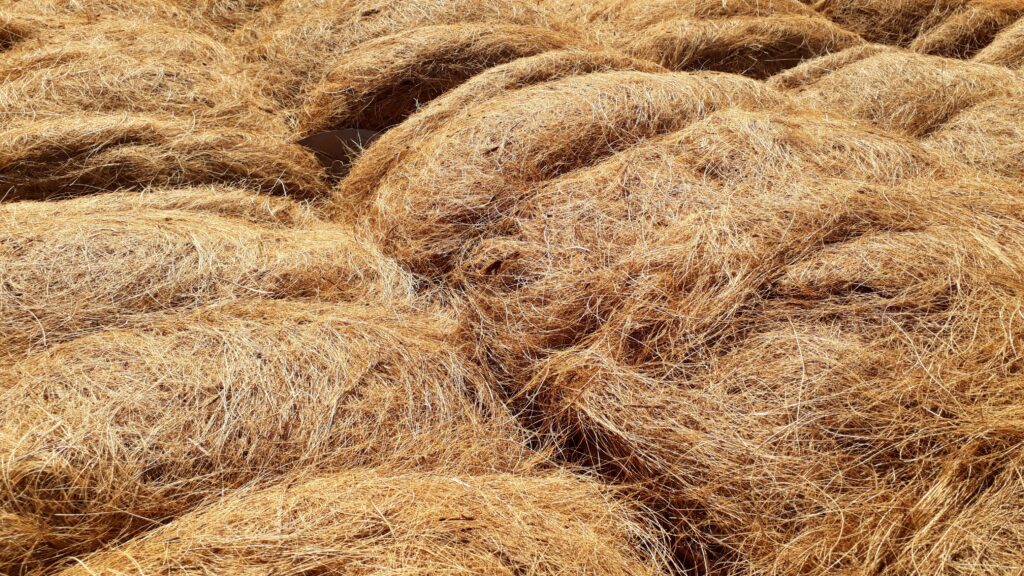
- Grades
- Natural (industrial) or washed (substrate)
- Formats
- Bales, ~24 kg; export bales on committed volume
- Uses
- Geotextiles and erosion-control blankets, mattresses, composites, structural substrates
 2027
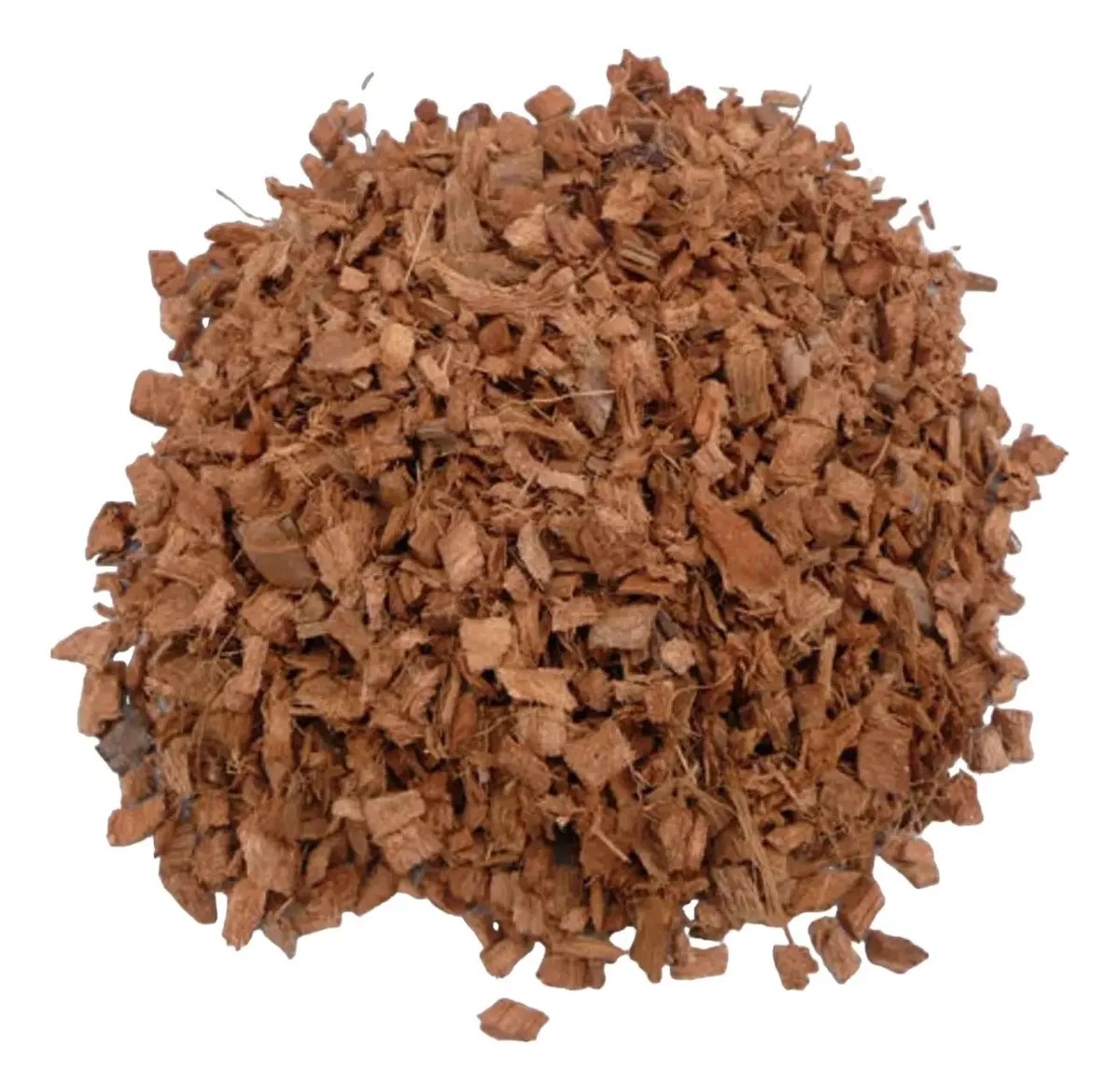
2027- Grades
- Washed; 10–20 mm cut from whole husk
- Formats
- Compressed blocks or bags; roadmap product
- Uses
- Orchids, blueberries, drainage layers, chip-pith blends for multi-year crops
Product photographs: our own material at the processing yard in Ceará. Photographs of the compressed block format and of hydrated ("expanded") material are supplied with each quotation.
Coco peat block specification.
Acceptance limits written into the contract and measured on every lot before it leaves the plant. Price is quoted per order, FOB Pecém, according to grade, volume and payment terms.
< 0.5 mS/cm bufferedWashed with artesian well water. Buffered: calcium and magnesium treatment after washing.
Why dry inland husk gives lower salt at source.
Most coir is made from husk that is retted, soaked for weeks in brackish coastal lagoons, which loads sodium chloride into the pith. The material is then washed, often with brackish water, to remove part of the salt the process added. Research on Indian and Sri Lankan coir found EC coefficients of variation between 39 % and 165 % across batches (Prasad, Acta Horticulturae 450, 1997).
Our husk is collected dry from rain-fed farms 15–25 km inland, where it lies under the palms for months and is leached by 1,000–1,400 mm of annual rainfall. It is never submerged. When we wash, we use artesian well water at 64–480 µS/cm. Reaching low EC takes two to three freshwater cycles instead of the five or more documented for high-salt material (Raviv, Lieth & Bar-Tal, Soilless Culture, 2019, ch. 8).
| Parameter | Retted coastal coir (typical) | Carve, inland Brazil |
|---|---|---|
| Retting | Brackish lagoon, weeks to months | None |
| Starting EC, raw | 3.0 – 11.25 dS/m (1:1.5)¹ | ~1.0 – 1.5 mS/cm (1:5)² |
| Sodium | 1 – 3 % | 0.38 % (EMBRAPA) |
| Wash water | 2,000 – 5,000+ µS/cm | 64 – 480 µS/cm, artesian well |
| Wash cycles to low EC | 5 or more¹ | 2 – 3 |
| Traceability | Aggregated across retting yards | Single origin, lot report + QR |
From Brazil or from India: the route to your port.
Green lines are Carve's routes from Pecém. Grey lines are the routes coir takes from India and Sri Lanka today, mostly around the Cape of Good Hope; red dashed lines pass through the Red Sea and the Suez Canal, disrupted since late 2023. Hover or tap a destination to compare.
| Destination | From Pecém, Brazil | From South India / Sri Lanka | Route exposure |
|---|---|---|---|
| New York / US East Coast | As little as 6 days, weekly direct (APM Terminals) | Around the Cape or with transhipment; no published figure | Atlantic only from Brazil |
| Algeciras / Spain | As little as 6 days, weekly direct (APM Terminals) | ≈ 30–38 days via the Cape; ≈ 18–22 days when routed through Suez | Red Sea on the Suez routing |
| Rotterdam / Northern Europe | ≈ 2 weeks, weekly direct service | ≈ 35–45 days via the Cape; ≈ 22–28 days through Suez | Red Sea on the Suez routing |
| Hamburg / Antwerp / UK | ≈ 2 – 2.5 weeks | ≈ 35–45 days via the Cape | Red Sea on the Suez routing |
| Turkey (Mersin / Istanbul) | Via Algeciras; days per carrier quotation | Through Suez when open; via the Cape otherwise | Red Sea |
| Canada (Halifax / Montreal) | Atlantic; days per carrier quotation | Around the Cape or with transhipment | Atlantic only from Brazil |
| UAE / Gulf | Per quotation | ≈ 5–9 days, direct | India is the closer origin |
| Japan / Korea / China / Australia | Per quotation | Direct Indian Ocean and Pacific routes, unaffected | India is the closer origin |
Transit figures: APM Terminals Pecém (service pages, "as little as six days to New York or Algeciras"); DatamarNews and FluentCargo for the Northern Europe loop; Euronews (14 Aug 2026) and GoFreight (2026) for Cape routing and the partial return of some Maersk, Hapag-Lloyd, CMA CGM and MSC services to Suez; India–Europe days are carrier and forwarder ranges, not a fixed schedule. Where no reliable figure exists the table says so.
Included with each container.
Coir enters the USA, UK, Canada, Japan and Australia duty-free under HS 5305; the EU applies 0 % on this line; Turkey applies the EU tariff for industrial goods and is expected to be duty-free, to be confirmed by your broker. USDA APHIS requires no import permit for soil-free processed coir; the EU does not require a phytosanitary certificate for unused stand-alone coir substrate. We issue the MAPA certificate anyway, because most buyers ask for it.
From first contact to the container.
Minimum order one 40' high-cube. Monthly allocations are scheduled per quarter; the next export allocation opens in the first quarter of 2027. "We can buy 2 containers per month" is a sentence we can plan around.
Questions importers ask before a first order.
How many liters does a 5 kg block expand to?
At least 13 L per kg, so at least 65 L per 5 kg block after hydration. The block measures 30 × 30 × 14 cm and loads 22 pallets per 40' high-cube, 23–24 tonnes net.
Is the coco peat washed or buffered, and what EC level?
Both grades are available. Washed: EC below 0.7 mS/cm (1:5). Buffered, treated with calcium and magnesium after washing: EC below 0.5 mS/cm. The raw material is dry inland husk that was never retted, so it starts at a lower salt level. Every lot is measured before shipping and the limit is written in the contract.
Could you make an FOB offer, and from which port?
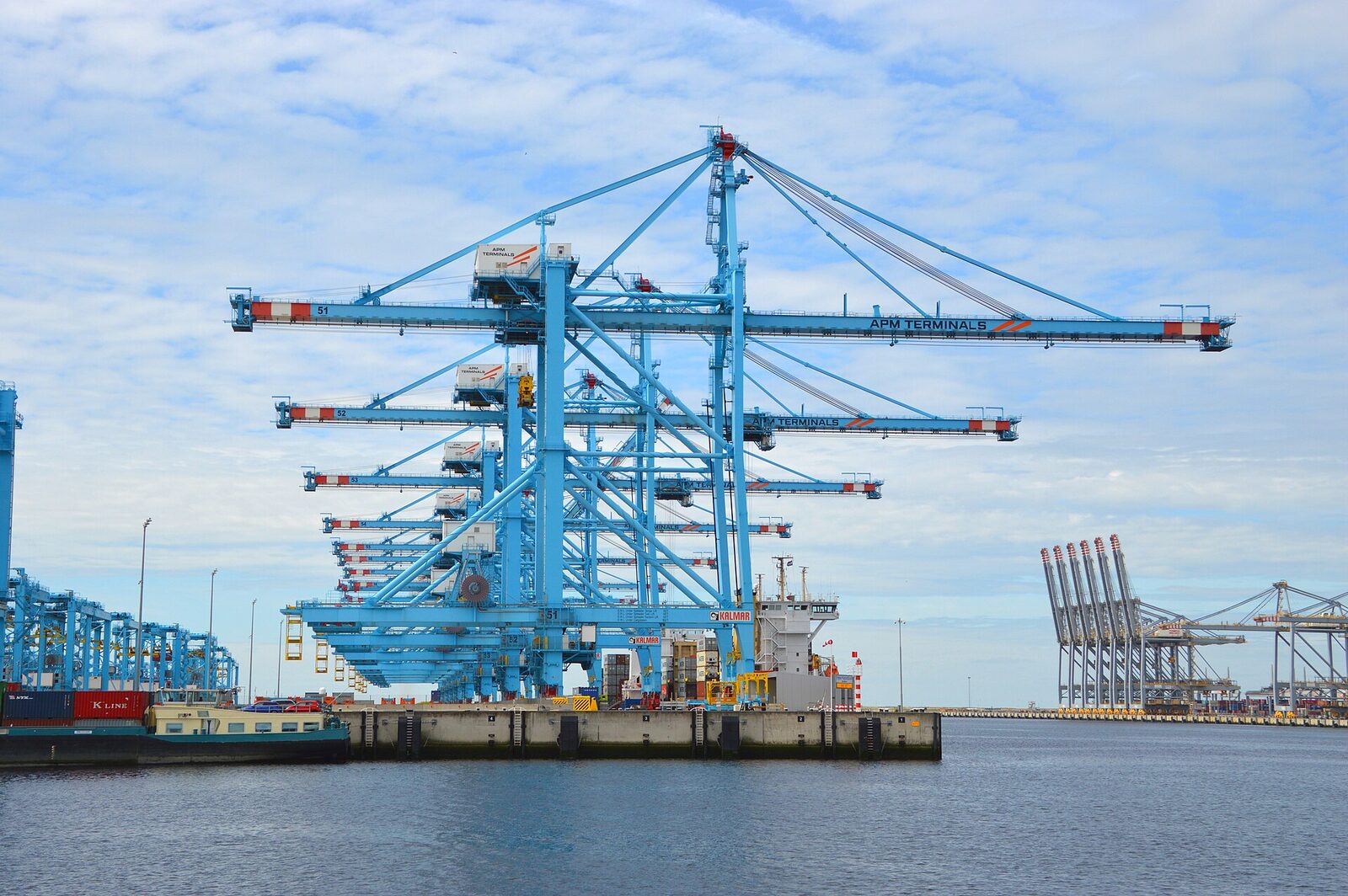
Yes. Offers are FOB Port of Pecém, per 40'HC. CFR or CIF on request. Pecém has weekly direct services to the US East Coast, Northern Europe and the Western Mediterranean; APM Terminals publishes transit of as little as six days to New York and Algeciras.
What is the payment term?
Agreed per order: advance with balance against the B/L copy, documents against payment (D/P) for established relationships, or letter of credit for larger recurring contracts.
Which documents come with the shipment, and is there import duty?
Invoice, packing list, B/L, MAPA phytosanitary certificate, fumigation certificate where required, certificate of origin, ISPM-15 pallet certificate and the lot analysis report. Coir (HS 5305) is duty-free into the USA, UK, Canada, Japan and Australia and 0 % in the EU; Turkey is expected to be duty-free, to be confirmed by your broker.
Why buy from Brazil instead of India?
Season: the dry season in Ceará runs June to December, while India's southwest monsoon (June–September) and Tamil Nadu's northeast monsoon (October–December) slow drying and processing. Route: Pecém to Europe and the US East Coast is an Atlantic crossing without the Suez Canal or the Red Sea; most India–Europe services still sail around the Cape in 2026. Raw material: husk that is not retted carries less sodium and needs fewer wash cycles to reach low EC.
Can we test the material first?
Yes. Samples are sent for your own laboratory with our lot report and photographs of the hydrated block. Independent inspection at stuffing can be arranged at Pecém.
Do you also supply coir fiber, coir mix and husk chips?
Coir fiber and coir mix are available now in bales or bags. Husk chips (10–20 mm, cut from whole husk) are a roadmap product for 2027; inquiries are answered with pith and fiber options in the meantime.
Request an FOB Pecém offer
Send the product, grade, format, monthly volume and destination port. We reply with the specification sheet, an example lot report and the offer within two working days.
- APM Terminals Pecém, shipping lines and services — apmterminals.com/en/pecem.
- Governo do Ceará / CIPP, Pecém 2025 results (706,509 TEU; 20.96 Mt), 24 Feb 2026 — ceara.gov.br.
- DatamarNews, Pecém weekly reefer service to Europe, 2025/26 — datamarnews.com.
- Euronews, "Maersk returns another Asia–Europe service through Suez, but wider return remains distant", 14 Aug 2026 — euronews.com; Maritime Executive on MSC's return to the Red Sea.
- GoFreight (2026), maritime disruption guide: Cape diversion adds 10–14 days.
- USITC Harmonized Tariff Schedule, heading 5305.00.00 — hts.usitc.gov; UK Integrated Online Tariff 5305000000; CBSA Customs Tariff 2026 ch. 53; Japan Customs tariff ch. 53; Australian Border Force Working Tariff ch. 53.
- USDA APHIS, Circular Q37-2 (coir as approved growing medium and packing); Regulation (EU) 2019/2072, Annexes VII and XI.
- FUNCEME, quadra chuvosa and dry season in Ceará; India Meteorological Department, southwest and northeast monsoon.
- Raviv, M., Lieth, J.H. & Bar-Tal, A. (2019), Soilless Culture, 2nd ed., Elsevier, ch. 8; Prasad, M. (1997), Acta Horticulturae 450; EMBRAPA Tabuleiros Costeiros, Comunicado Técnico 226.
- MAPA, e-Phyto and Vigiagro procedures; ISPM-15 (IPPC).
Page updated 5 September 2026. Third-party figures are reproduced as published; where no reliable figure exists the page says so.