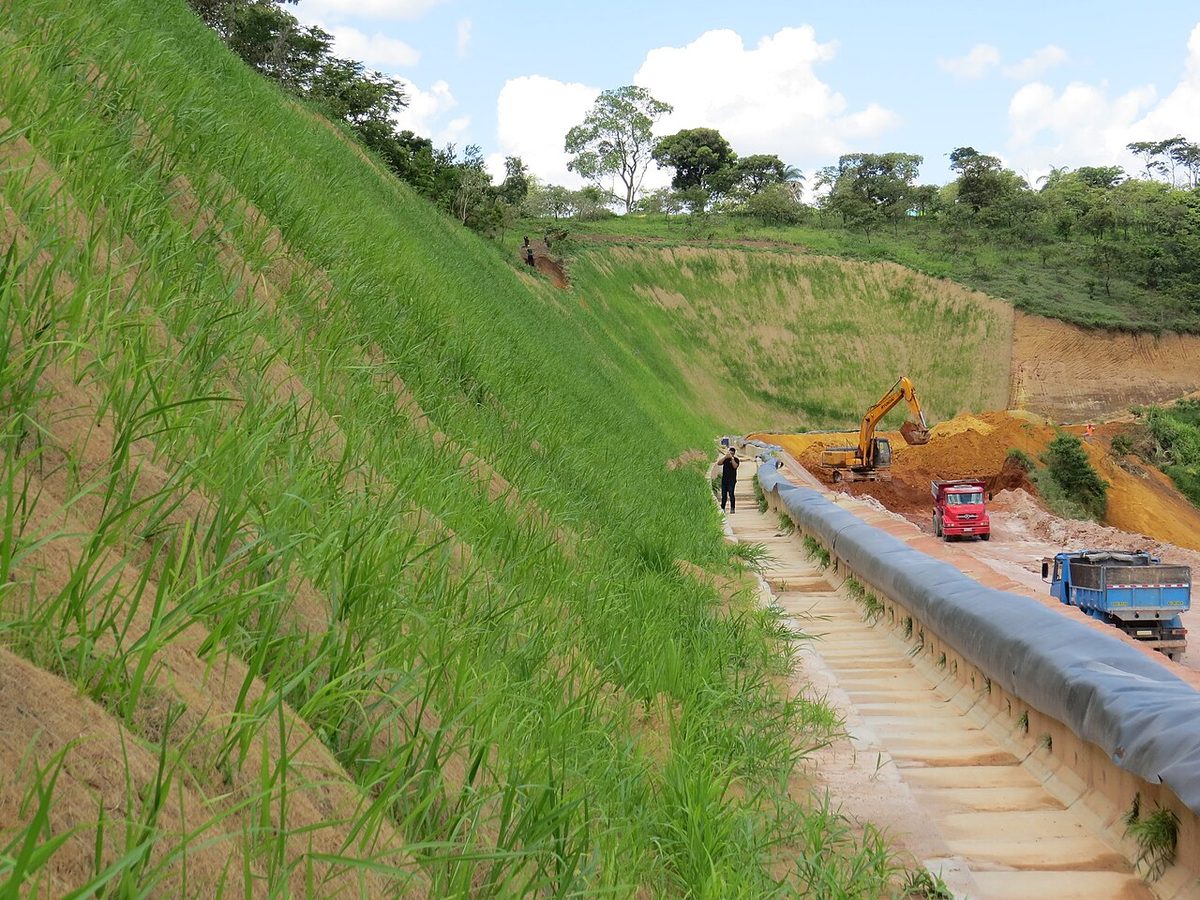
Coir Fiber for Geotextile Biomats and Erosion Control
Natural-grade long coir fiber, 10-40 cm and raw (not combed), is the raw material specification for biomantas (erosion-control geotextile blankets) mandated by Brazil's DNIT Norm 074/2006 for highway slope stabilization, an industrial application where salt content (EC) is irrelevant because the material remains in soil contact throughout its service life [1]. Carve's Fibra de Coco is produced at ~28% of husk weight, with tensile fiber length in this range and lignin content of 35-45% supporting multi-season durability before biodegradation [2].
The agronomic and physical case
Coir fiber's suitability for erosion-control geotextiles comes from a combination that few natural materials offer simultaneously: meaningful tensile strength, biodegradability on a multi-year (not multi-decade) timescale, and a cost structure competitive with synthetic geotextile alternatives. DNIT Norm 074/2006, Brazil's federal highway infrastructure standard, specifically mandates coir biomantas for slope stabilization projects — meaning this is not an optional or preference-based specification but a defined technical requirement with legal standing in public infrastructure procurement [1][3]. The mechanism is straightforward: a woven or needle-punched mat of long coir fiber is laid over a freshly graded slope, holding the soil surface against rain and wind erosion while vegetation establishes root systems through the mat's open weave. As the vegetation matures and its own root network takes over the soil-holding function, the coir mat biodegrades — coir's relatively high lignin content (35-45% in Carve's fiber) means this degradation happens over a multi-year window rather than washing away in the first rainy season, giving the vegetation enough time to establish before the temporary structure disappears [2][4].
Fiber length matters directly to mat mechanical performance: longer fibers interlock and hold the woven or needle-punched structure together under the stress of rainfall impact and slope movement, which is why the 10-40 cm long-fiber specification (as opposed to short fiber or fine pith) is the standard raw material for this application, not a preference [2]. Salinity is a non-factor for this use case in a way that distinguishes it sharply from every horticultural application in this content set — the fiber sits in direct soil contact on an open slope, salts leach into the surrounding soil and rainfall within days to weeks, and no plant root is confined to a small container where a temporary EC spike could cause osmotic stress. This means Natural-grade fiber, without any washing step, is the correct and most cost-effective specification for biomanta manufacturing, and washing would add cost with no functional benefit [1][5].
Technical specification
Values are guarantees measured and printed per lot; the QR code on every bag links to the full bench-test report.
| Parameter | Carve Fibra de Coco — Natural, Geotextile/Biomanta grade |
|---|---|
| Raw material | Fiber from the mesocarpo of dry mature coconut husk (Cocos nucifera L.), Ceará coast, dry-farmed groves, never retted; screen-retained fraction (~4.1 mm screen), raw, not combed |
| Fiber length | 10-40 cm, natural long fiber, no cutting |
| Yield | ~28% of husk dry weight |
| Moisture at dispatch | Guaranteed ≤18% |
| Bulk density (loose) | ~55-80 kg/m3, lot-specific value provided |
| Lignin content | 35-45% (literature value; high resistance to decomposition, supports multi-year service life) |
| Water-holding capacity | ~300 ml/L — the lowest of the Carve product line, reflecting fiber's role as the maximum-aeration, structural format |
| Total porosity | >94% |
| Tensile strength | Structural-grade, suitable for needle-punch or woven biomanta manufacture per DNIT 074/2006 |
| CE / pH | Measured per lot; not a functional criterion for this application |
| Format | Pressed bales for transport; weight and volume on request (internal reference: 24 kg bales) |
Control per lot
Every lot is analysed before dispatch. Lots outside the agreed range are held back.
Step by step
- Specify fiber length and lignin content to your biomanta manufacturer or contractor; Carve's 10-40 cm raw long fiber is the input format for needle-punch or woven mat production, not a finished mat itself — Carve supplies the raw fiber, the mat is manufactured downstream.
- Confirm your project's DNIT 074/2006 compliance requirements with your engineering or procurement team before specifying fiber source; the norm governs the finished biomanta product specification, which the manufacturer is responsible for meeting using appropriate raw fiber.
- For manufacturers: process the raw fiber through standard needle-punching or weaving equipment per your production line's established parameters; Carve's fiber requires no pre-washing or chemical treatment for this application.
- For installers: lay the finished biomanta per standard slope-stabilization practice — graded slope, secured mat edges (staking or trenching per project spec), seed or vegetation establishment through the mat's open structure.
- Monitor vegetation establishment through the first one to two rainy seasons; the mat's structural role diminishes as root systems take over, consistent with the multi-year lignin-driven degradation timeline.
- Coordinate freight and bale format with Carve directly — biomanta manufacturing is typically a bulk, industrial-scale raw-material purchase rather than a small-lot order, and logistics should be planned accordingly.
- Request lot documentation (fiber length distribution, moisture, lignin reference) if your project's technical file requires raw-material traceability for public infrastructure procurement.
The data behind this application
- ~6,500 t/yrestimated Brazilian demand for coir fiber in biomanta/geotextile manufacturing, driven by DNIT 074/2006's highway slope-stabilization mandate [1][6].
- 1 tonne ≈ 3,000 m²approximate finished biomanta coverage per tonne of raw coir fiber input [1].
- ~28%fiber's share of total husk dry weight in Carve's processing [7].
- 35-45%lignin content of Carve's coir fiber, the structural basis for multi-year decomposition resistance [2].
- ≤18%Carve's guaranteed dispatch moisture, relevant to freight efficiency for bulk industrial buyers [8].
- 10-40 cmCarve's natural long-fiber length range, unretted and uncut [2].
What this product does not do
Coir fiber for biomantas is a raw material, not a finished engineered product — Carve supplies fiber; the biomanta itself (woven or needle-punched mat, sized and specified per project) is manufactured by a downstream converter, and project-level DNIT 074/2006 compliance is the manufacturer's and specifying engineer's responsibility, not something the raw fiber alone guarantees. This raw fiber is explicitly not suitable for finer craft, brush, or broom applications — Carve's fiber is described as 'raw, not combed,' distinct from the higher-processing bristle-grade fiber used in those industries. Biomantas are a temporary erosion-control measure, not a permanent slope-stabilization solution; they buy time for vegetation establishment and are expected to biodegrade over a multi-year window, so project engineering must plan for vegetation to take over the soil-holding function, not rely on the mat indefinitely. Salinity/EC testing, while performed on every lot for traceability consistency across Carve's product line, has no functional bearing on this specific application and should not be treated as a differentiator between Natural and Washed fiber for biomanta use — Natural is the correct and only necessary specification here.
Carve's product for this application
Carve's Fibra de Coco for geotextile and biomanta manufacturing is produced from the mesocarpo of dry mature coconut husk grown in irrigated coconut groves on the Ceará coast, never retted in brackish or tidal water, and irrigated with low-conductivity well water (64-480 µS/cm) — though for this specific industrial application, the origin story's relevance is less about salt chemistry (irrelevant here) and more about fiber integrity and consistency: unretted husk preserves fiber structure differently than the retting process common in parts of the Asian coir industry, where prolonged water soaking is specifically used to loosen and separate fiber, a process that trades some structural integrity for ease of extraction [9]. Carve's fiber is mechanically separated through screening after shredding, yielding raw, uncombed long fiber (10-40 cm) at approximately 28% of husk weight, with a lignin content (35-45%) supporting the multi-year durability that DNIT-spec biomantas require [2][7]. Every bale carries lot documentation accessible via QR code, covering origin, moisture and processing date, useful for public infrastructure procurement files that require raw-material traceability. Fiber is also sold as substrate-grade (Washed, for orchid and ornamental applications — see /en/products/coir-fiber-orchid-substrate) and for other industrial uses including mattress pads (see /en/products/coir-fiber-mattress-pads). For the full product line, see /en/products/coir-fiber, /en/products/coir-pith and /en/produc../husk-chips; for export logistics and buyer questions, see /en/import-coir-from-brazil.
References
- [1] DNIT Norm 074/2006-ES (Brazilian national highway infrastructure standard) — coir biomanta mandate for slope stabilization, cited in Carve internal research `coir-products-use-cases-grades-2026-09-01.md` §3.2.
- [2] Carve internal specification, `mvp-product-specs.md` §3a — fiber length (10-40 cm), lignin content (35-45%), bulk density, uncombed classification.
- [3] Carve internal research, `coir-products-use-cases-grades-2026-09-01.md` §3.2 — biomanta/geotextile power users (Deflor Bioengenharia, Minas Gramados, NTC Brasil, GW Fibras, CBFT).
- [4] General geotextile/erosion-control engineering literature on biodegradable slope-stabilization matting — cross-referenced with Carve internal lignin-content data.
- [5] Carve internal research, `coir-products-use-cases-grades-2026-09-01.md` §3.2 — industrial fiber uses classified as EC-irrelevant (Natural grade recommended across all listed industrial applications).
- [6] Carve internal research, `coir-products-use-cases-grades-2026-09-01.md` §7.1 — ~6,500 t/yr biomanta segment sizing within total addressable fiber demand.
- [7] Carve internal mass-balance model, `mvp-product-specs.md` §3d-bis — fiber yield ~28% of husk dry weight.
- [8] Carve internal competitive intelligence, `mvp-product-specs.md` §8 — dispatch moisture guarantee ≤18%.
- [9] General coir-industry retting literature, cross-referenced with Raviv (Soilless Culture, 2nd ed., Ch. 8) discussion of origin/processing effects on fiber and pith properties.
Frequently asked questions
What coir fiber grade is used for erosion-control biomantas?
Natural (unwashed) grade — salinity has no functional role in this application since the fiber remains in continuous soil contact and salts leach away naturally within weeks. Washing would add cost with no benefit for this use case [1][5].
Is coir biomanta legally required for Brazilian highway projects?
DNIT Norm 074/2006 mandates coir biomantas for highway slope stabilization in applicable projects, making this a defined technical requirement in public infrastructure procurement rather than an optional material choice [1].
How much biomanta coverage does one tonne of coir fiber produce?
Approximately 3,000 m² of finished biomanta per tonne of raw fiber input, though the exact yield depends on the manufacturer's specific weave or needle-punch density [1].
How long does a coir biomanta last before it biodegrades?
Coir fiber's lignin content (35-45% in Carve's material) supports a multi-year service life, giving vegetation time to establish root systems before the mat naturally biodegrades — the exact timeline depends on climate and site conditions [2][4].
Does Carve manufacture finished biomantas, or just the raw fiber?
Carve supplies the raw long coir fiber (10-40 cm, Natural grade); the finished biomanta (woven or needle-punched mat) is manufactured by downstream geotextile converters using this raw material.