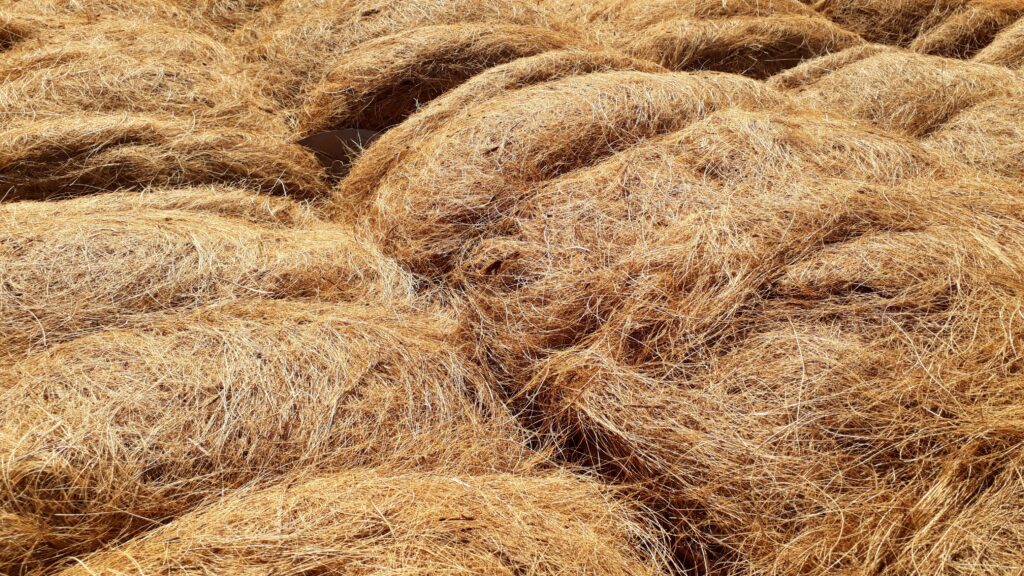
Coir logs from Brazil: 20 to 40 cm, FOB Pecém.
Carve Substrates is a coir log supplier in Brazil. We pack our own brown coir fibre into tubular netting at the plant in Paraipaba, Ceará, in diameters of 20, 30 and 40 cm, to your project's length, density and netting, and ship FOB from the Port of Pecém.
In short
- Coir logs (coir fibre rolls, sediment retainers) made in Brazil by the fibre producer, from fibre decorticated at the same plant.
- Diameters 20, 30 and 40 cm (about 8, 12 and 16 in). Length, fibre mass per metre and netting per project specification.
- Fill: brown coir fibre from mature dry husk, Natural grade, 10–40 cm, moisture ≤18%.[1]
- Netting: synthetic tubular net (PP or HDPE) or natural-fibre net.
- Every log weighed, measured and tagged with lot, diameter, length and mass.
- FOB Port of Pecém. Transit to Newark (New York area) 8 to 9 days, an indicative range from Carve's US import guide.
What a coir log does
On a bare slope, rain runs off in a sheet, speeds up and carries soil into ditches, culverts and streams. A coir log laid on the contour breaks that flow: water seeps through the fibre more slowly and sediment settles on the uphill side. Over time the trapped soil forms a small berm that holds seed and moisture until vegetation takes over. Brazil's federal road standard DNIT 074/2006-ES describes the device as "fibras vegetais desidratadas, prensadas, e enroladas formando cilindro flexível e resistente" (dehydrated plant fibres, pressed and rolled into a flexible, resistant cylinder).[2]
The fill is the same brown coir fibre Carve sells in bales: mature dry husk, with a high lignin content, the property that slows decomposition in soil.[1] If you make your own logs or blankets and need the fibre instead, see coir fibre for erosion-control manufacturers.
In the United States, sediment retention devices such as fibre rolls are tested for sheet-flow performance under ASTM D7351.[4] Where your specification requires that test or others, it is run by an external laboratory on the specified log.
Coir log specification
Fibre values are the guarantees of Carve's public coir fibre specification. Log values (diameter, length, mass per metre, netting) are fixed in the order from your specification and checked log by log before loading.
Checked log by log
Every log is weighed and measured before loading. A log outside the tolerance agreed in the order is not shipped.
Where coir logs are used
- Road and rail cut and fill slopes. Contour lines across the slope face, the use described in DNIT 074/2006-ES.[2]
- Slope toes, ditches and culvert outlets. Where runoff concentrates and carries sediment off site.
- Shoreline and stream banks. Public guidance for coastal banks describes coir rolls 12 to 20 inches in diameter, typically 10 to 20 feet long, installed at the toe of the bank; over 5 to 7 years plants take over site stabilization.[5]
- Mine closure and land reclamation. Benches, waste-pile faces and haul-road slopes; in Peru, mine closure plans follow Ley 28090.[7]
- Wind farms, transmission lines and construction sites. Access-road fills, pads, tower bases, stockpiles and site perimeters.
How coir logs are installed
- Lay the log across the slope on the contour, in a trench one third of the log height deep (DNIT 074/2006-ES).[2]
- Butt the ends of adjacent logs tightly and tie them to form a continuous line.
- Stake with steel, wood or bamboo long enough to reach firm soil.[2] A US detail for fibre wattles uses 18–24 in stakes every 3–4 ft plus one at each end.[8]
- Backfill and compact the soil on the uphill side so water cannot pass under the log.
- Seed or hydroseed uphill as the revegetation design requires.
Line spacing follows the project. The University of Michigan wattle detail uses the spacing below as a function of slope.[8]
| Slope (H:V) | Spacing between lines |
|---|---|
| Steeper than 1:1 | 5 ft (1.5 m) |
| 2:1 to 1:1 | 10 ft (3.0 m) |
| 4:1 to 2:1 | 20 ft (6.1 m) |
| 5:1 to 4:1 | 25 ft (7.6 m) |
| Flatter than 6:1 | 50 ft (15.2 m) |
Source: University of Michigan, detail SD-SESC Straw Wattle. For reference; the project's drawings govern.
What a coir log does not do
- It is not a retaining structure. It does not hold a slope with deep-seated instability; that needs geotechnical design.
- It does not replace drainage. In concentrated flow it works with the drainage system, not instead of it.
- It is temporary. The fibre decomposes over time; permanent protection comes from the vegetation.[5]
- It does not work loose on the surface. Without a trench and staking, water runs under the log or moves it.
- It is not graded by EC. The fill is Natural-grade fibre; salt content matters for growing media, not for a log on a slope.
Transit to ports in the Americas
Port to port, before customs at destination.
| Destination port | Transit from Pecém | Status | Source |
|---|---|---|---|
| Newark, US East Coast | 8–9 days | Indicative | Carve US import guide |
| Savannah / Miami, US | 10–14 days | Indicative | Carve US import guide |
| Callao, Peru (via Panama) | 10–14 days | Indicative | Carve Peru import guide |
| Mexico and Costa Rica ports | Per carrier quotation | No published figure | — |
The figures are indicative ranges from carrier schedules summarised in Carve's import guides. The carrier's booking confirms the sailing. Terms, documents and country notes: coir fibre for buyers in the Americas.
Terms, packing and lead time
- Incoterm: FOB Port of Pecém, Ceará. CFR on request through our forwarder.
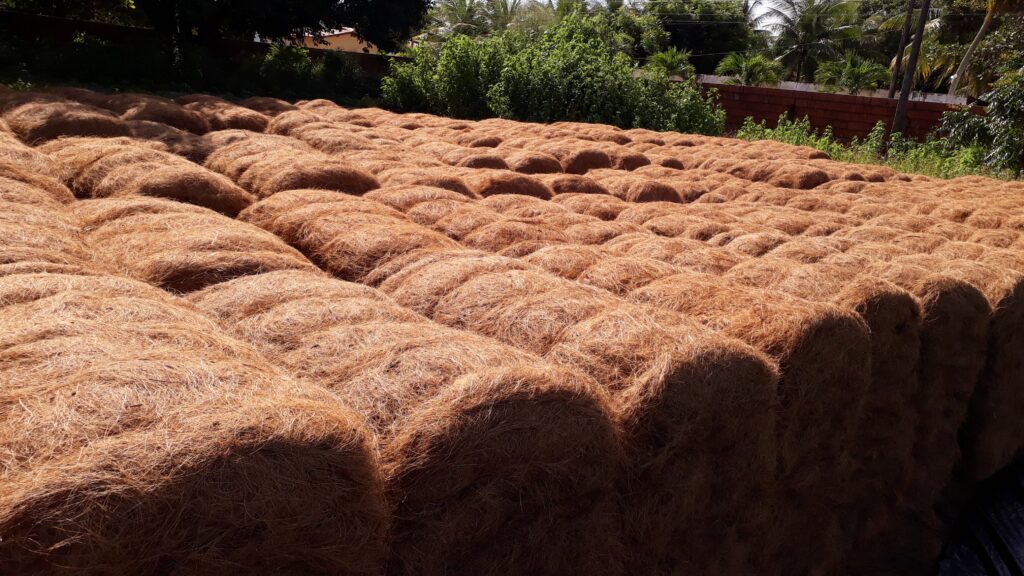
- Packing: tagged logs in bundles, loaded without pressing that would deform the cylinder. Logs per container depend on the diameter and length mix and are confirmed with the offer.
- Lead time and minimum order: agreed per order, based on the metres and diameters.
- Documents: commercial invoice, packing list (piece count and weights), bill of lading, certificate of origin, lot record. Phytosanitary certificate issued by MAPA when the destination requires it or the buyer asks for it.[9]
- Duties: depend on the destination and change with trade policy; confirm the rate with your customs broker.
- Samples: a sample log or cut section with its lot record, by courier, on request.
Frequently asked questions
What is a coir log?
A flexible cylinder of coconut husk fibre packed into a tubular net. Laid on the contour of a slope, at the toe of a bank or across a drainage outlet, it slows runoff and holds back sediment while vegetation establishes. Brazil's federal road standard DNIT 074/2006-ES calls it a sediment retainer or artificial berm.
Which sizes do you make?
Diameters of 20, 30 and 40 cm (about 8, 12 and 16 inches). Length per piece, fibre mass per metre and netting are set in the order from your project specification.
What density or weight per foot do you supply?
The one your specification calls for. Each log is weighed and its mass is printed on the tag. For reference, Brazil's public cost table (SICRO) assumes 3.14 kg per metre for a 20 cm retainer, which is 100 kg/m³.
Can the netting be fully biodegradable?
Yes. Netting is either synthetic tubular net (polypropylene or HDPE) or natural-fibre net. Your project decides, based on the site and the service life required.
Which Incoterm and documents?
FOB Port of Pecém, Ceará; CFR on request through our forwarder. Commercial invoice, packing list with piece count and weights, bill of lading, certificate of origin and lot record; phytosanitary certificate issued by MAPA when the destination requires it or the buyer asks for it.
How long is transit to the United States?
Carve's US import guide gives 8 to 9 days to Newark (New York area) and 10 to 14 days to Savannah or Miami as indicative ranges.
Sources
- Carve public data sheet, Coir Fiber and coir fibre specification: length 10–40 cm, moisture ≤18 %.
- DNIT (Brazil's federal transport infrastructure department), standard DNIT 074/2006-ES, items 3.8 and 5.4.2. gov.br/dnit (PDF, Portuguese).
- DNIT, SICRO cost reference reports, Ceará, April 2026: material M0129 and composition 4413017, "Retentor de sedimento em fibras vegetais – D = 20 cm", transport weight 0.00314 t per metre. gov.br/dnit.
- ASTM D7351/D7351M, Standard Test Method for Determination of Sediment Retention Device (SRD) Effectiveness in Sheet Flow Applications. store.astm.org.
- Massachusetts Office of Coastal Zone Management, StormSmart Properties Fact Sheet 4, Bioengineering: Coir Rolls on Coastal Banks. mass.gov (PDF).
- Pecém container terminal, shipping lines and services page. Terminal shipping-lines page.
- Ministerio de Energía y Minas (Peru), Ley y Reglamento que regula el Cierre de Minas, ed. 2023. gob.pe.
- University of Michigan, detail SD-SESC Straw Wattle: trench, staking and spacing by slope. umaec.umich.edu (PDF).
- MAPA (Brazil), phytosanitary certification for plant-product exports. gov.br/agricultura.
Sources accessed 25 September 2026. Written by Carve Biorrefinaria Agroindustrial Ltda, Paraipaba, Ceará, Brazil. First published 25 September 2026.
Request a coir log specification and FOB offer
Send the diameter, length, quantity in metres or pieces, netting type and destination port, or your project specification. We reply with the log specification, the lead time and an FOB Pecém offer.