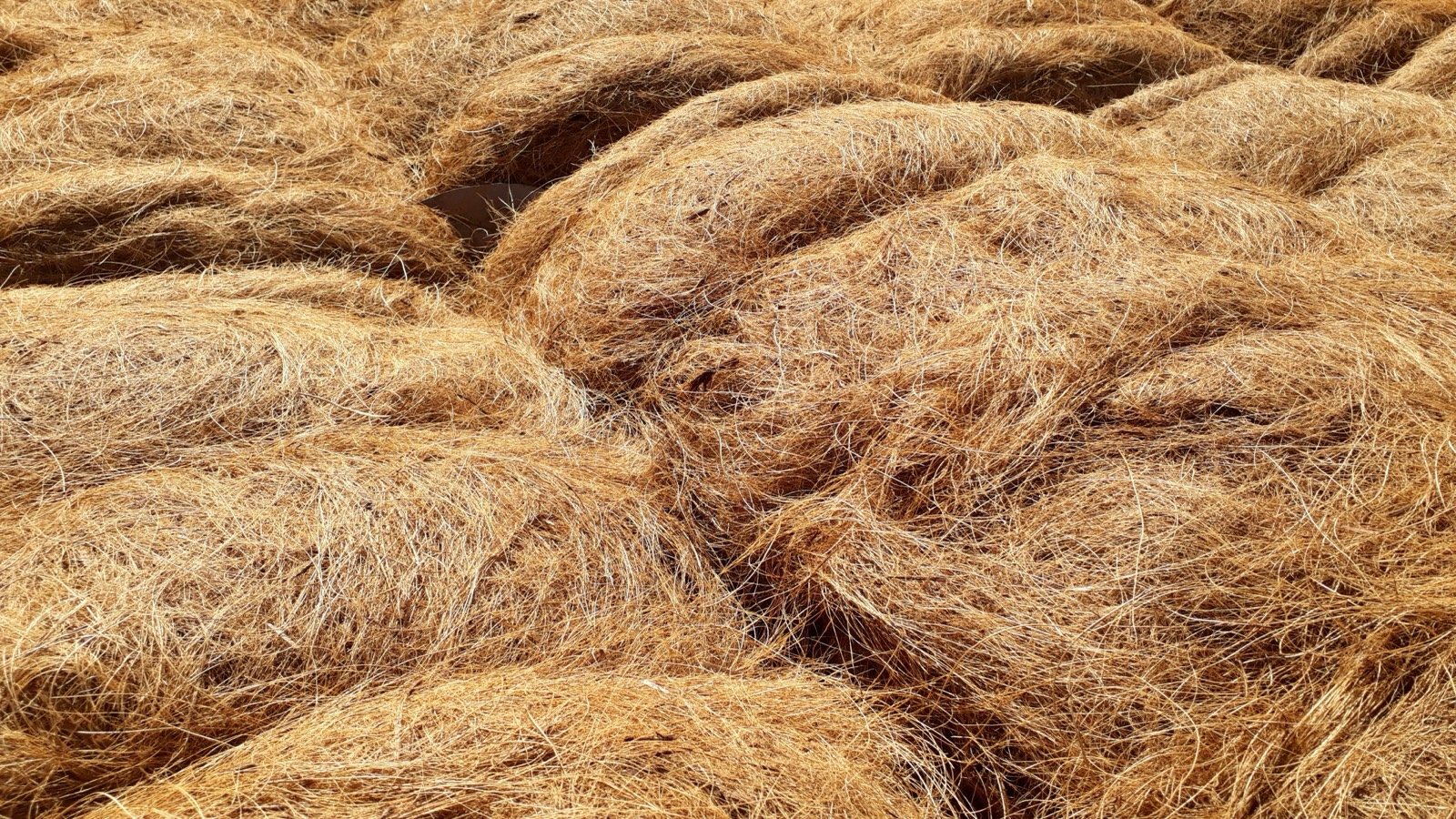
Coir horse bedding from Brazil
Coir horse bedding made of short coir fibre and coarse coir pith from mature dry coconut husk, screened to remove the fine fraction and pressed into 25 kg bags. For importers, distributors and equestrian-supply wholesalers. Made in Ceará, Brazil, and shipped FOB Pecém with a lot report.
Photo: loose coir fibre. Credit: UsiCoco.
In short
- Stall bedding of short coir fibre (2–8 cm) and coarse coir pith (1–10 mm), 40–60% fibre by mass.
- Fines removed on the screen: particles under 1 mm are at most 10% of the mass.
- Target moisture 15–20% at bagging: dry enough not to mould in the bag, moist enough not to raise dust when spread.
- No chemicals, no fragrance, no disinfectant. Not a feed.
- Pressed 25 kg bags; 10 kg bags on request. Palletised or floor-loaded, FOB Pecém.
- Lot report with moisture, fines, fibre-to-pith ratio, EC and pH.
- Spent bedding with manure can be composted.
What stall bedding has to handle
Urine and moisture. Bedding absorbs urine and keeps the surface the horse lies on dry. A stalled 1,000 lb horse needs 60 to 70 lb (27–32 kg) of manure and soiled bedding removed per day (Rutgers NJAES, FS537).
Ammonia. Ammonia comes from urine held in the bedding. Concentrations of 20 to 25 mg/m³ in stable air are considered high and irritate the lining of the airways (NFACC, 2012).
Dust. Disturbing the bedding while bedding down raises airborne dust 3 to 6-fold (NFACC, 2012), and the bedding material changes how many particles reach the stable air (Fleming et al., 2008).
Labour and disposal. Soiled bedding comes out every day (Rutgers NJAES). The longer the bed stays dry, the less material goes into and out of the stall, and the smaller the muck heap.
What Carve coir bedding is
A blend of two fractions of the dry coconut husk: short fibre, 2 to 8 cm, and coarse pith with husk pieces, 1 to 10 mm. The fibre builds the structure of the bed, lets urine drain and holds the pith in place; the coarse pith is the absorbent part. The blend is 40 to 60% fibre by mass, measured on every lot.
The bedding is screened to take out the fine pith, the fraction that raises dust, and pressed into 25 kg bags. It is not washed and receives no chemicals or additives. Dry mature husk from irrigated groves, never retted in brackish water; EC and pH measured per lot. The same raw material makes Carve's coir fibre and coir pith.
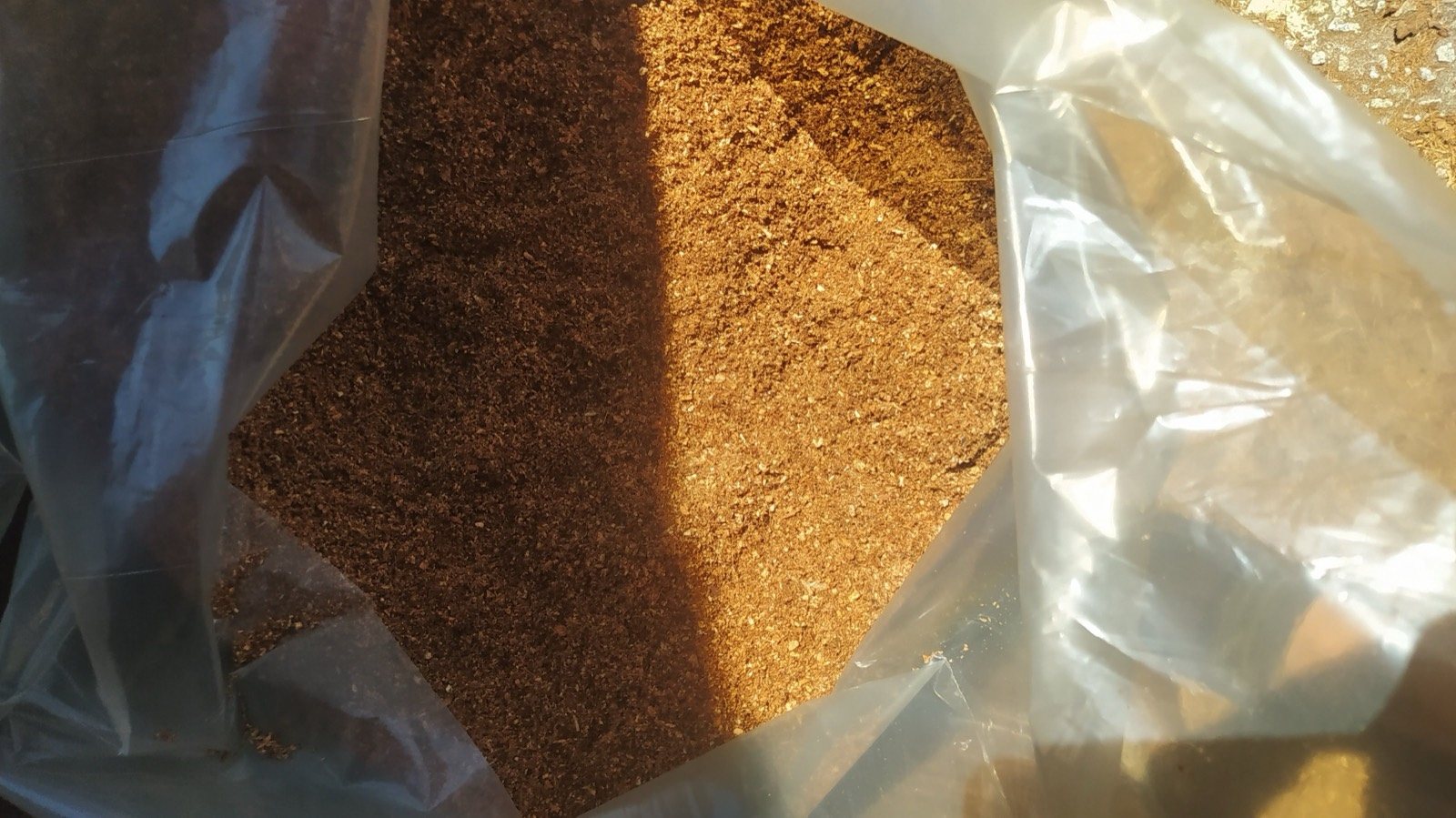
Absorption, ammonia and dust of coir as bedding
The reference study compared cocopeat and sawdust as cattle bedding. No peer-reviewed study of coir bedding with horses has been published yet; the figures below come from cattle and from the laboratory.
| Measure | Cocopeat | Sawdust | Source |
|---|---|---|---|
| Water absorption after 12 h submersion (% of own weight) | 678–702% | 444% | Ahn et al., 2016 |
| Mean ammonia emission in the laboratory, 1–36 h | 1.22–1.59 mg/m²/h | 2.71 mg/m²/h | Ahn et al., 2016 |
| Time to bedding replacement in the barn, with fans | ≈ 8 weeks | 4–5 weeks | Ahn et al., 2016 |
| Dust | Higher, from a high share of fine particles (≤250 µm) | Lower | Ahn et al., 2016 |
Source: Ahn G-C et al. (2016), Asian-Australasian Journal of Animal Sciences 29(3):444–454, paper. The cocopeat in the study was not screened for fines. The last row of the table is the reason Carve bedding is fibre with coarse pith and leaves the screen without the fine fraction.
Coir horse bedding specification, parameter by parameter
Supply specification. Each lot is measured at the plant and the values go on the lot report; see how to read a lot report and quality control.
Control per lot
Moisture, fines, fibre-to-pith ratio and bag weight are checked on every lot before dispatch. A lot outside the specification does not leave the plant.
How to bed and keep a stall
Management guidance for your customers, based on extension publications. Adjust to the floor, the ventilation and the stable routine.
- 01Loosen before spreading. The bedding is pressed. Open the bag, break up the blocks and spread evenly.
- 02Bed to the right depth. On a dirt floor 3 to 4 inches (8–10 cm) is usually adequate; on concrete or asphalt, at least 8 to 10 inches (20–25 cm) (Purdue Extension, AS-553-W).
- 03Clean daily. Remove manure and wet spots every day and replace with fresh bedding (Rutgers NJAES, FS537). Pull dry bedding from the edges to the centre.
- 04Clean with the horse out. Dust rises when bedding is disturbed; clean and refresh the stall when the horse is turned out (NFACC, 2012).
- 05Top up and strip. Add fresh bedding when the layer drops. Strip the stall when the bed loses structure or the base turns wet and smells.
- 06Store dry. Bags under cover, on pallets, away from flames and heat sources.
Bags per stall depend on the stall area, the floor and the depth; monthly use depends on management. We work out the starting quantity with each distributor.
Spent bedding: composting
Horse manure with its bedding is well suited to composting, because it combines nitrogen-rich manure with carbon-rich bedding. Stall waste composts well in piles at least 3 feet (0.9 m) square by 3 feet deep (Penn State Extension).
The goal is a pile interior of 130 to 150 °F (54–66 °C), which speeds decomposition and kills pathogens and weed seeds, at about 50% moisture, the feel of a wrung-out sponge. Composting microbes work best near a C:N ratio of 30:1; horse manure is typically about 40:1 (Extension Horses).
Coir fibre breaks down slowly. Allow more time in the pile than for manure alone, and turn the pile to keep it hot.
What coir bedding does not do
- Not a treatmentIt is bedding. It does not treat or prevent disease and does not replace ventilation, daily cleaning or veterinary advice.
- Not dust-freeScreening removes the fine fraction, but any bedding releases some dust when disturbed. Clean with the horse out.
- Not a feedNot intended for animal consumption. If a horse eats its bedding, remove it and consult a veterinarian.
- No substitute for cleaningIn stalls without drainage, wet spots must come out every day, as with any bedding.
- Keep it dry in storageBags left in rain or on damp floors can mould. Store under cover, on pallets.
- Not a growing mediumFor pots and propagation use coir pith or coir fibre. See coir fibre uses.
Terms, documents and samples
- Incoterm: FOB Port of Pecém, Ceará; CFR on request through our forwarder.
- Packing: pressed 25 kg bags (10 kg on request) with lot label, palletised or floor-loaded; bags per container confirmed with the quotation.
- Documents: commercial invoice, packing list, bill of lading, certificate of origin and lot report.
- Phytosanitary certificate: issued by MAPA, Brazil's Ministry of Agriculture, when the destination requires it or the buyer asks for it.
- Samples: bags from a production lot sent by courier with the lot report.
The bedding is made in Paraipaba, Ceará, in the same plant that produces Carve's coir fibre and coir pith, and ships from the Port of Pecém. Routes, transit times and documents for importers are on importing coir from Brazil. More about Carve.
To quote, send the destination port, the monthly volume, the pack size and whether you sell to stables, retail stores or both.
Frequently asked questions
What is Carve coir horse bedding made of?
Short coir fibre (2 to 8 cm) and coarse coir pith with husk pieces (1 to 10 mm) from mature dry coconut husk, 40 to 60% fibre by mass. The fine pith fraction is screened out. No chemicals, fragrance or disinfectant are added.
Is coir bedding dusty?
Fines under 1 mm are held to at most 10% of the mass, and the bedding is bagged at a target moisture of 15 to 20%, because very dry material releases more dust. In a cattle study, unscreened cocopeat produced more dust than sawdust because of its fine particles (Ahn et al., 2016); that is why this bedding is fibre with coarse pith. Any bedding releases some dust when disturbed, so stalls are best cleaned with the horse out.
How much bedding goes into a stall?
It depends on the stall area, the floor and the depth. Extension guidance puts 3 to 4 inches (8 to 10 cm) on a dirt floor and at least 8 to 10 inches (20 to 25 cm) on concrete or asphalt (Purdue Extension, AS-553-W). Monthly use depends on management.
How is it packed and shipped?
Pressed 25 kg bags, or 10 kg bags on request, each with a lot label, palletised or floor-loaded and shipped FOB Port of Pecém, Ceará. The number of bags per container is confirmed with the quotation. Documents: commercial invoice, packing list, bill of lading, certificate of origin and lot report; phytosanitary certificate issued by MAPA when the destination requires it.
Does the bedding make any health claim?
No. It is plain bedding with no additives. It does not treat or prevent disease, it is not a veterinary product and it is not a feed.
Can spent coir bedding be composted?
Yes. Horse manure with its bedding is well suited to composting because it combines nitrogen-rich manure with carbon-rich bedding (Penn State Extension). Keep piles at least 3 feet square by 3 feet deep and near 50% moisture; coir fibre breaks down slowly, so allow extra time.
Sources
- Ahn G-C et al. (2016). Characteristics of sawdust and cocopeat beddings, and their usefulness according to the fan and pen location for rearing Hanwoo cattle. Asian-Australasian Journal of Animal Sciences 29(3):444–454. animbiosci.org
- Fleming K, Hessel EF, Van den Weghe HFA (2008). Generation of airborne particles from different bedding materials used for horse keeping. Journal of Equine Veterinary Science. sciencedirect.com
- NFACC (2012). Code of Practice for the Care and Handling of Equines: Review of Scientific Research on Priority Issues. nfacc.ca
- Rutgers NJAES (2013). FS537, Horse Manure Management: Bedding Use. njaes.rutgers.edu
- Brady CM, Kanne KS, Russell MA (2002). Introduction to Housing for Horses, AS-553-W. Purdue University Cooperative Extension Service. extension.purdue.edu
- Penn State Extension (2019). Horse Stable Manure Management. extension.psu.edu
- Extension Horses. Horse Manure Management. horses.extension.org
- Photos: UsiCoco (loose coir fibre; screened coir pith).
Distributing stall bedding? Ask for a sample and an FOB Pecém offer.
Send the destination port, the monthly volume and the pack size. We reply with a sample from a production lot, its lot report and an FOB Pecém offer.