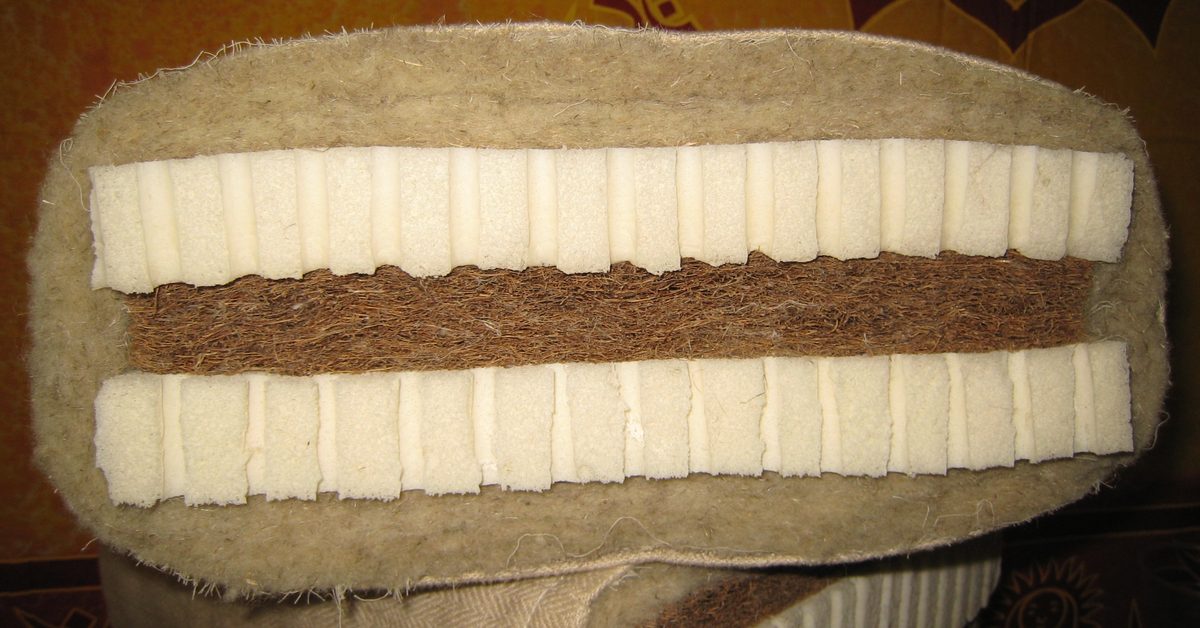
Coir Fiber for Needle-Punch Mattress Pads
Natural-grade long coir fiber (10-40 cm, raw, uncombed) is the raw material specification for needle-punched coir mattress pads, an industrial bedding application where salinity is irrelevant and the value drivers are fiber length, tensile strength and consistent supply for continuous manufacturing runs [1]. Carve's Fibra de Coco meets this specification at approximately 28% of husk weight, sold as an industrial raw material rather than a horticultural substrate for this use case [2].
The agronomic and physical case
Coir has been used as a natural fiber filling for bedding and mattress applications for decades, valued for a combination of properties that synthetic foam does not replicate: natural resilience (the fiber springs back rather than compressing permanently), breathability (an open fiber structure that does not trap heat and moisture the way closed-cell foam can), and biodegradability at end of life [1][3]. Needle-punching — a mechanical process that interlocks loose fiber into a coherent, self-supporting mat using barbed needles rather than adhesive — is the standard manufacturing method for converting raw long fiber into a usable mattress-pad layer, and it depends on fiber length and tensile integrity to form a mat that holds together under repeated compression over years of use [1][4]. This is why long fiber (10-40 cm, as opposed to short fiber or dust) is specifically required: shorter fiber fragments do not interlock into a durable needle-punched structure the same way.
As with biomantas, mattress pad manufacturing is an industrial application where the coir's salt content is functionally irrelevant — the fiber is not in a root zone, there is no osmotic stress mechanism, and no plant is involved at any point in the product's life cycle. This places mattress pad fiber firmly in the Natural-grade category alongside other industrial uses (geotextiles, automotive composites, brooms, doormats), where the only meaningful specifications are physical (fiber length, tensile strength, consistent bulk density for manufacturing throughput) rather than chemical (EC, pH) [1][5]. Carve's ≤18% moisture guarantee is directly relevant here in a way distinct from the horticultural applications: mattress pad manufacturers running continuous needle-punch production lines need dry, consistent input material — wet fiber behaves differently under the needling process and can affect mat density and durability, so moisture control is a manufacturing-quality issue as much as a freight-cost issue for this buyer segment.
Technical specification
Values are guarantees measured and printed per lot; the QR code on every bag links to the full bench-test report.
| Parameter | Carve Fibra de Coco — Natural, Mattress Pad / Industrial grade |
|---|---|
| Raw material | Fiber from the mesocarpo of dry mature coconut husk (Cocos nucifera L.), Ceará coast, dry-farmed groves, never retted; screen-retained fraction (~4.1 mm screen), raw, not combed |
| Fiber length | 10-40 cm, natural long fiber, no cutting |
| Yield | ~28% of husk dry weight |
| Moisture at dispatch | Guaranteed ≤18% — important for consistent needle-punch processing |
| Bulk density (loose) | ~55-80 kg/m3, lot-specific value provided |
| Lignin content | 35-45% (literature value; supports fiber durability under repeated mechanical compression) |
| Tensile strength | Structural-grade, suitable for needle-punch interlocking |
| Total porosity | >94% |
| CE / pH | Measured per lot for traceability; not a functional criterion for this application |
| Format | Pressed bales for transport; weight and volume on request (internal reference: 24 kg bales) |
Control per lot
Every lot is analysed before dispatch. Lots outside the agreed range are held back.
Step by step
- Specify fiber length requirements to Carve directly, confirming your needle-punch line's tolerance for fiber length distribution within the 10-40 cm range.
- Coordinate freight and delivery volume for continuous manufacturing needs — mattress pad production typically requires steady, scheduled raw-material supply rather than one-off orders, and Carve can discuss standing supply arrangements.
- Verify moisture on receipt against the ≤18% guarantee before introducing fiber to the needle-punch line; excess moisture can affect needling consistency and finished mat density.
- Process through standard needle-punch equipment per your production line's established parameters; Carve's raw fiber requires no pre-treatment for this application.
- Quality-check finished mat density and tensile integrity per your own product specifications, using Carve's lot documentation (fiber length, moisture, bulk density) as an input-traceability reference if needed.
- Store unprocessed bales in a dry environment before use to maintain the moisture specification through your production queue.
- Discuss volume forecasting with Carve for larger, recurring industrial orders — bulk industrial fiber supply is typically priced and logistically planned differently from smaller horticultural-scale orders.
The data behind this application
- R$9,000/tapproximate premium value for finished needle-punched coir mattress pad material, reflecting the value-add of the needle-punch manufacturing step over raw fiber [1].
- ~28%fiber's share of total husk dry weight in Carve's processing [6].
- 35-45%lignin content supporting fiber durability under repeated mechanical compression over a mattress pad's service life [2].
- ≤18%Carve's guaranteed dispatch moisture, directly relevant to needle-punch manufacturing consistency [7].
- 10-40 cmCarve's natural long-fiber length range, the raw material format required for needle-punch interlocking [2].
- Part of an estimated ~10,000 t/yr Brazilian fiber demand across all industrial uses (mattress pads, geotextiles, automotive, doormats, brooms combined)mattress pads are a sub-segment within this total [8].
What this product does not do
Carve supplies raw long fiber, not finished needle-punched mattress pad product — the needle-punch manufacturing step (equipment, process control, finished-product certification for bedding applications) is the responsibility of the downstream manufacturer, not something the raw fiber specification alone determines. As with other industrial fiber uses, salinity/EC testing is performed for lot traceability consistency across Carve's product line but has no functional bearing on mattress pad performance — this is purely a physical-fiber application, and buyers should not expect or request a specific EC specification for this use case. Fiber length distribution within a bale is a natural material property, not a manufactured-to-tolerance specification the way a synthetic fiber would be; buyers with very tight length-uniformity requirements should discuss expected variation with Carve directly rather than assume industrial-uniform input. Bedding-industry certifications (flammability, allergen, or other regulatory requirements specific to finished mattress products in the buyer's target market) are the manufacturer's responsibility and are separate from raw fiber sourcing.
Carve's product for this application
Carve's Fibra de Coco for mattress pad manufacturing is produced from the mesocarpo of dry mature coconut husk grown in irrigated coconut groves on the Ceará coast, never retted in brackish or tidal water. For this industrial application, the origin story is less about salt chemistry — irrelevant to mattress pad performance — and more about consistent fiber quality from a controlled, traceable sourcing process: dry-husk fiber that has not been through a prolonged water-retting process retains more of its original tensile structure, which is the physical property that matters for needle-punch interlocking and long-term mat durability [3][4]. Carve's fiber is mechanically separated through screening after shredding, yielding raw, uncombed long fiber (10-40 cm) at approximately 28% of husk weight, with a lignin content (35-45%) that supports durability under years of repeated mechanical compression in bedding use [2][6]. Carve's guaranteed ≤18% dispatch moisture supports consistent needle-punch processing for manufacturers running continuous production lines. Every bale carries lot documentation accessible via QR code. Fiber is also sold for geotextile/biomanta use (see /en/products/coir-fiber-geotextile-biomats) and washed substrate-grade for orchid and ornamental applications (see /en/products/coir-fiber-orchid-substrate). For the full product line, see /en/products/coir-fiber and /en/products/coir-pith; for export and international buyer questions, see /en/import-coir-from-brazil.
References
- [1] Carve internal research, `coir-products-use-cases-grades-2026-09-01.md` §3.2 — mattress pad segment, R$9,000/t premium reference, Fernando Pessoa (BA) power user.
- [2] Carve internal specification, `mvp-product-specs.md` §3a — fiber length (10-40 cm), lignin content (35-45%), uncombed classification.
- [3] General coir-industry literature on coir fiber use in bedding and mattress applications, historical industrial use context.
- [4] General needle-punch nonwoven manufacturing process literature, cross-referenced with Carve internal fiber specification.
- [5] Carve internal research, `coir-products-use-cases-grades-2026-09-01.md` §3.2 — industrial fiber uses classified as EC-irrelevant (Natural grade across all listed industrial applications).
- [6] Carve internal mass-balance model, `mvp-product-specs.md` §3d-bis — fiber yield ~28% of husk dry weight.
- [7] Carve internal competitive intelligence, `mvp-product-specs.md` §8 — dispatch moisture guarantee ≤18%.
- [8] Carve internal research, `coir-products-use-cases-grades-2026-09-01.md` §3.2 — ~10,000 t/yr total industrial fiber demand across mattress pads, geotextiles, automotive, doormats, brooms.
Frequently asked questions
What grade of coir fiber is used for mattress pads?
Natural (unwashed) grade — salinity is irrelevant to this industrial application. The specification that matters is fiber length (10-40 cm) and tensile strength for needle-punch interlocking [1][5].
Does Carve manufacture finished mattress pads?
No, Carve supplies raw long coir fiber as an industrial input. Needle-punch mattress pad manufacturing is done by downstream converters using this raw fiber.
Why is fiber length important for needle-punched coir products?
Longer fiber (10-40 cm) interlocks more effectively under the needle-punch process, producing a coherent, durable mat. Shorter fiber fragments do not hold together the same way [1][4].
Why does moisture content matter for mattress pad fiber specifically?
Beyond the freight-cost implications relevant to all bulk fiber buyers, moisture affects needle-punch processing consistency and finished mat density — wet fiber behaves differently under the needling process, making Carve's ≤18% dispatch guarantee a manufacturing-quality factor for this segment [7].
How does Carve's sourcing benefit mattress pad manufacturers?
Carve's husk is never retted, preserving more of the fiber's original tensile structure compared to fiber from prolonged water-retting processes, which is directly relevant to needle-punch interlocking quality and long-term mat durability under repeated compression [3][4].