Coir fibre for doormats: which fibre each mat type uses
Coir fibre for doormats is not one material. Tufted mats and woven mats use coir yarn, bristle mats use combed fibre, and rubberised mats use loose brown fibre bonded with latex. Carve Substrates supplies the loose brown fibre, in pressed bales, for makers of the last type.
Carve coir fibre is brown mixed fibre, loose and uncombed, 10 to 40 cm long. It suits mat makers who bond the fibre with latex or press it into a mat: Embrapa records short fibre being used for doormats and latex-impregnated fibre as rubberised coir[1]. It does not suit PVC-backed tufted mats, which use coir yarn[2], or brush-type bristle mats, which use combed fibre[3].
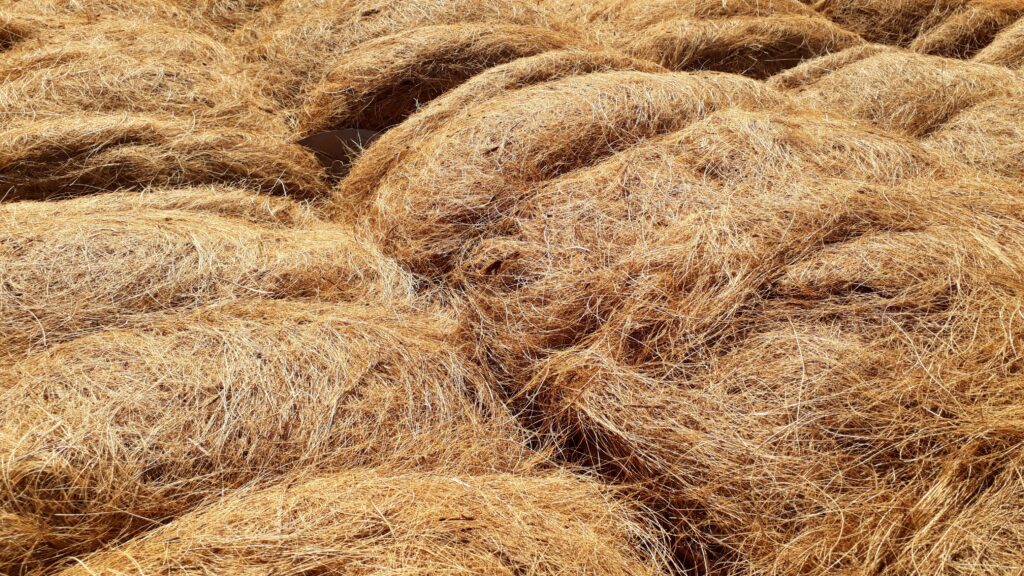
Coir doormat types and the fibre each one uses
Buyers looking for coir fibre for doormats are usually in one of two positions: starting a mat line and deciding what raw material to buy, or already making mats and looking for another source. In both cases the first question is the mat type, because each type uses a different form of the fibre.
| Mat type | Raw material | Does Carve fibre fit? | Source |
|---|---|---|---|
| PVC-backed tufted coir mat | Coir yarn, natural or dyed, tufted into a PVC compound | No. Carve does not spin yarn | [2] |
| Woven mats and mattings (loom-made) | Coir yarn | No. Carve does not spin yarn | [1][2] |
| Brush-type bristle mat | Long combed and sorted bristle fibre, the class used in brushes | No. Carve fibre is not combed | [3] |
| Rubberised or pressed-fibre mat | Loose brown fibre, short or long, bonded with natural rubber latex and pressed | Yes, Natural grade | [1][3] |
Carve supplies only the last row of the table: loose brown fibre. Coir yarn and combed fibre require steps Carve does not perform, such as spinning and hackling. If you make tufted mats, this fibre only fits if you spin the fibre yourself, and a sample is then the first test.
Why brown fibre from mature coconuts is used for mats
FAO separates coir into two types: brown fibre, obtained from mature coconuts, and finer white fibre, extracted from green husks after soaking for up to 10 months. Brown coir is the stronger and more widely used of the two, and FAO lists doormats and rugs among its uses[4]. Wikipedia records the same: brown coir is used in floor mats and doormats, brushes, mattresses and sacking[3].
Coir fibre has a high lignin content, which gives it stiffness and resistance to decomposition[5].
Carve fibre comes from the mesocarp of dry mature coconut husk, decorticated dry and separated from the pith on a ~4.1 mm rotary screen: dry mature husk from irrigated groves, never retted in brackish water, EC measured per lot[5]. It is brown mixed fibre, short and long strands together, 10 to 40 cm, uncombed. That mix is what a rubberised mat uses; sorting by length and combing, which a bristle mat requires, are not part of the Carve process.
How a rubberised coir mat is made
Rubberised fibre results from impregnating the fibre with latex[1]; in industry, brown coir pads are sprayed with natural rubber latex, which bonds the fibres together[3]. A rubberised mat line generally follows this sequence:
- Open the bales and loosen the fibre.
- Curl or twist the fibre, if your process uses curled fibre for loft and spring.
- Form the fibre mat at the thickness and weight of the finished product.
- Apply natural rubber latex by spraying or impregnation[1][3].
- Press and dry the mat according to the latex formulation.
- Cut to size and finish the edges.
Latex formulation, drying temperature, mat weight and dyeing are the maker's decisions. Carve delivers dry fibre, 18% moisture or less, for step 1[5].
Coir fibre specification for doormats
| Parameter | Carve coir fibre | Source |
|---|---|---|
| Raw material | Mesocarp fibre of the mature dry coconut husk (Cocos nucifera L.) | [5] |
| Fibre class | Brown mixed fibre, loose, not combed; not yarn, not bristle, not curled | [5] |
| Process | Decorticated mechanically; fibre retained on a ~4.1 mm rotary screen; no additives | [5] |
| Length | 10–40 cm, natural length, uncut | [5] |
| Moisture | ≤ 18%, measured on every lot | [5][6] |
| Impurities (pith and dust) | Limit agreed per contract; lot data on request | [5] |
| Loose bulk density | ~55–80 kg/m³, actual value per lot | [5] |
| Lignin | High (literature on coir fibre) | [5] |
| Colour | Natural brown, undyed | [5] |
| Grade for mats | Natural (EC 0.8–1.5 mS/cm, 1:5, measured per lot); Washed by contract | [5] |
| Bale | Pressed bales of loose fibre; export bales 100–130 kg, floor-loaded 40-foot HC, FOB Pecém | [5] |
In a doormat the fibre has no contact with roots; EC is measured on every lot for traceability but does not affect the product.
Numbers with sources
| Indicator | Value | Source |
|---|---|---|
| Brazil imports of coir floor coverings (NCM 5702.20.00), Jan–Dec 2025 | about 1,237 t | [7] |
| Share of those imports from India | about 98% (1,216 t) | [7] |
| Soaking time of green husks for white fibre | up to 10 months | [4] |
| Carve fibre length | 10–40 cm | [5] |
| Maximum moisture at dispatch | 18% | [5] |
| Lignin in coir fibre (literature) | High | [5] |
NCM 5702.20.00 covers woven floor coverings of coconut fibre. The figure is the net weight imported in the year, from Comex Stat.
What this fibre does not do
- It is not coir yarn. Tufted and woven mats need yarn; Carve does not spin.
- It is not combed or length-sorted fibre, so it does not suit bristle mats, brooms, brushes or handicrafts.
- It is not curled or rubberised fibre. It ships loose, without latex; curling, latex and pressing are the maker's.
- It is not dyed. The colour is the natural brown of mature coir.
- It is not a finished mat. Carve supplies raw material in bales.
How to order coir fibre for your mat line
- Send the mat type, the bonding process (latex, pressing, needling) and your monthly volume.
- Receive a fibre sample from a production lot, with the report of that lot.
- Test the sample on your line and tell us what you need: maximum moisture, pith limit, bale format.
- The contract fixes the grade, the acceptance limits, the bale format and the delivery schedule.
- Every bale ships with a lot number and QR code; a lot outside the contract limit does not ship[6].
The product page is Coir Fiber; the full data sheet is the coir fibre specification; bristle, mattress, mixed and twisted fibre are explained in coir fibre grades; lot testing is on Quality. Other industrial uses of the same fibre: mattress pads, geotextile biomats and molded pots.
See all coir pith and coir fibre applications · Contact sales
References
- Correa, M. U. Fibra de coco na indústria (Coir fibre in industry). Embrapa Technology Information Agency (Ageitec), Coconut Knowledge Tree. Embrapa Ageitec, Fibra de coco na indústria
- Central Coir Research Institute (Coir Board, Government of India). Intensive Training Courses for Coir and Coir Products: Manufacture of PVC Tufted Coir Mats; Manufacture of Coir Mattings. Coir Board, Intensive Training Courses (PDF)
- Wikipedia. Coir (sections on brown coir, bristle coir and rubberised coir). Wikipedia, Coir
- FAO, Food and Agriculture Organization of the United Nations. Future Fibres: Coir. FAO, Future Fibres: Coir
- Carve Substrates. Coir fibre specification: parameters, grades (EC 1:5 per lot), bales and loading. Carve, coir fibre specification · Carve, Coir Fiber
- Carve Substrates. Quality: five bench tests per lot, dispatch decision and QR code. Carve, Quality
- Comex Stat, Brazilian Ministry of Development, Industry, Trade and Services (MDIC). Imports, NCM 5702.20.00, January to December 2025, net kg by country. Comex Stat, MDIC (queried 25 September 2026)
Questions about coir fibre for doormats
What kind of coir fibre is used to make doormats?
It depends on the mat. PVC-backed tufted mats and woven mats use coir yarn; brush-type bristle mats use combed bristle fibre; rubberised and pressed-fibre mats use loose brown fibre bonded with latex. Embrapa records short fibre being used to make doormats.
Can Carve fibre be used for PVC-backed tufted coir mats?
Not directly. Tufted mats use coir yarn tufted into a PVC compound. Carve supplies loose fibre in bales and does not spin yarn.
Can the fibre be used for rubberised (latex-bonded) mats?
Yes. Rubberised coir is made from loose brown fibre sprayed or impregnated with natural rubber latex. Carve fibre is brown, loose, 10 to 40 cm long, moisture 18% or less. If your process uses curled fibre, the curling is done at your plant.
Does doormat fibre need to be washed?
Usually not. In a doormat the fibre has no contact with roots, so EC does not affect the product and the Natural grade works. The Washed grade is available by contract if your process calls for fibre with fewer soluble salts.
Does Carve sell coir yarn or finished doormats?
No. Carve supplies raw, uncombed coir fibre in pressed bales. Yarn, combed bristle and finished mats are outside the product line.
How do I get a sample for testing?
Send the mat type, the bonding process and your monthly volume to WhatsApp +55 11 99131-9577 or comercial@carvebio.com.br. The sample comes from a production lot, with its lot report.
Request a sample
Get a coir fibre sample from a production lot, with its lot report, to test on your mat line.