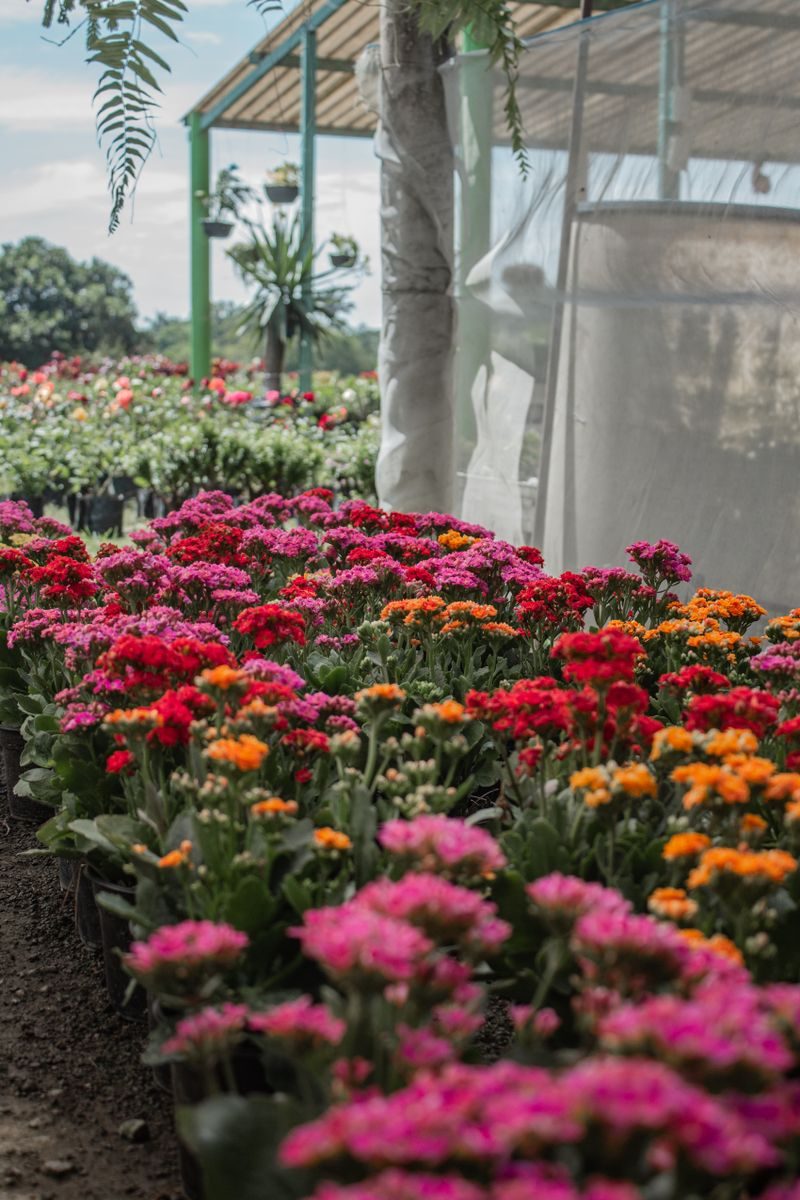
Coir Pith Substrate for Ornamental Flowers
Washed coir pith at EC below approximately 0.5 mS/cm (1:5 extract) is the standard specification for potted ornamentals and cut flowers over a 2-5 month pot cycle, a band already used at national scale in Brazil's Holambra flower cluster with washed, unbuffered coir-and-bark blends [1]. Carve's Washed pith, classified at malha 5 fio 20 (~4.13 mm) with predominantly under-2mm particles, meets this specification with EC and pH tested and printed per lot [2].
The agronomic and physical case
Potted ornamentals occupy a middle position on the coir salt-sensitivity spectrum: longer than a vegetable tray cycle (2-5 months versus 20-35 days) but shorter than a multi-year woody or fruiting crop, and typically grown for visual quality rather than yield, which raises the cost of any visible stress symptom relative to a food crop where a small yield dip may go unnoticed by the end buyer [1]. Ornamental growers in Brazil's largest flower-production cluster, centered on Holambra (São Paulo), already run washed-unbuffered coir and bark blends at scale, targeting substrate EC around 0.5 mS/cm at 1:5 dilution — a real-world precedent that Washed-grade coir, without the additional cost and process step of buffering, is adequate for the great majority of potted ornamental production [1].
The physical case for coir pith in ornamentals mirrors its case in other tube and pot applications: a fine, classified particle structure gives high total porosity (over 94%) and water-holding capacity (8-10x dry weight in the literature), producing consistent moisture in a pot without waterlogging — important for ornamentals grown under greenhouse conditions where irrigation is often automated on a fixed schedule rather than adjusted plant-by-plant [3][4]. Because pot cycles run several months, there is more time than in a vegetable tray for any residual salt issue to compound, which is the reason washing (not just sorting by husk age) is the standard recommendation rather than Natural grade for this segment — a genuine, if partial, mitigation compared to unwashed material, even though full buffering is reserved for the most salt-sensitive ornamental sub-segments like professional orchid production (see /en/products/coir-fiber-orchid-substrate) [1][5].
Technical specification
Values are guarantees measured and printed per lot; the QR code on every bag links to the full bench-test report.
| Parameter | Carve Washed Coir Pith — Ornamental grade |
|---|---|
| Raw material | Mesocarpo of dry mature coconut husk (Cocos nucifera L.), Ceará coast, dry-farmed groves, never retted |
| Process | Mechanical shredding + rotary screen classification (malha 5 fio 20, ~4.13 mm) + 2-3 freshwater soak-drain cycles |
| Particle size | Classified at ~4.13 mm screen; predominantly <2 mm fraction retained |
| EC (1:5 v/v) | Target ≤0.5 mS/cm, matching the level used in Brazil's Holambra ornamental cluster; measured every lot |
| pH | Reported per lot; raw dry-husk literature range 4.9-6.0, rising toward neutral after washing |
| Moisture at dispatch | Guaranteed ≤18% |
| Bulk density (loose, 15-20% moisture) | ~90-95 kg/m3, printed on the bag |
| Water-holding capacity | ≥5x dry weight guaranteed; literature reference 8-10x |
| Total porosity | >94% |
| Organic matter | ≥85% guaranteed (literature 91-95%) |
| Packaging | 100 L woven bag, lot QR code linking to filmed bench test + origin data |
| Chemistry context | K 1.60%, Cl 1.80%, Na 0.38% dry mass in the raw husk; theoretical EC ceiling of raw material 1.0-1.5 mS/cm before washing [6] |
Control per lot
Every lot is analysed before dispatch. Lots outside the agreed range are held back.
Step by step
- Confirm the printed lot EC is at or below your production target (0.5 mS/cm is the common Holambra-cluster benchmark) before scheduling a potting run.
- Pre-wet the pith to field capacity; dry coir pith resists initial wetting, and pot mixes should be moistened evenly before potting to avoid dry pockets against the container wall.
- Blend with bark, perlite, or Carve fiber (see /en/products/coir-fiber) if your program calls for a mixed medium rather than pure pith — many Brazilian ornamental operations run coir as one component of a formulated blend rather than 100% pith.
- Pot at standard density for the species; coir pith's fine structure supports good root-to-media contact for cuttings and young plants transplanted from plug trays.
- Irrigate on a schedule calibrated to the pot size and coir's water-holding curve; over-irrigation of a high-retention substrate in a greenhouse with limited air movement is a more common risk than under-irrigation.
- Fertigate per crop program; because the substrate starts from a low, tested EC baseline, the grower can dose the full intended nutrient program without allowance for an unknown substrate contribution.
- Track plant quality indicators (leaf tip burn, uneven color, stunting) through the cycle as an early warning system; these are the visible symptoms of a salt or nutrient imbalance in ornamentals and should trigger a leachate EC check.
The data behind this application
- ~9,000 t/yrestimated Brazilian addressable demand for washed coir pith in the ornamentals/flowers segment [7].
- 2-5 monthstypical pot cycle length for ornamental production [1].
- ≤0.5 mS/cmEC target used at scale in Brazil's Holambra flower cluster with washed-unbuffered coir blends [1].
- 400 producersapproximate size of the Veiling Holambra cooperative, the country's largest flower-production network and a major coir buyer [1].
- 1.0-1.5 mS/cmtheoretical maximum EC (1:5) of Carve's raw composition before washing [6].
- ≥94%total porosity of coir pith [3].
What this product does not do
Washed-grade coir pith is adequate for the majority of potted ornamental production, but the most salt-sensitive ornamental sub-segments — professional Phalaenopsis orchid production in particular — document root-tip necrosis from potassium and sodium exposure and generally require Buffered grade rather than Washed (see /en/products/coir-fiber-orchid-substrate for the orchid-specific discussion, which typically uses fiber rather than pith) [8]. Pot cycles running toward the longer end of the 2-5 month range, or grower programs using rainwater irrigation with minimal calcium/magnesium background, have less natural buffering from the water source itself and should monitor more closely for delayed potassium release, even on Washed-grade material — this is a water-chemistry interaction, not a substrate defect, and is worth discussing with your supplier if your irrigation source is soft or rain-fed. Coir pith alone does not provide the structural rigidity some ornamental container programs want for larger, longer-lived pot plants; blending with bark or chips is common practice for those programs.
Carve's product for this application
Carve's Washed Coir Pith for ornamentals is produced from mesocarpo of dry mature coconut husk grown in irrigated coconut groves on the Ceará coast, never retted in brackish or tidal water, and irrigated with low-conductivity well water (64-480 µS/cm). This stands in direct contrast to the retting process documented in the Asian coir literature, where husks are soaked in ponds, lagoons or tidal water to loosen fiber for extraction, adding sodium and chloride loading beyond the coconut's inherent chemistry — the literature documents fresh unwashed Tamil Nadu coir at 3.32-4.41 dS/m and raw east-coast material up to 11.25 dS/m [9]. Carve's own composition data (K 1.60%, Na 0.38%, Cl 1.80% dry mass) puts the theoretical EC ceiling at just 1.0-1.5 mS/cm even before washing, and the Washed grade is produced to bring finished product to the ≤0.5 mS/cm band already proven at scale in Brazil's largest ornamental production cluster [1][6]. Every 100 L bag carries a lot QR code opening the filmed bench test, origin data and processing date. For related applications see /en/products/coir-fiber-orchid-substrate and /en/products/coir-pith-vegetable-trays; for the full product line see /en/products/coir-pith, /en/products/coir-fiber and /en/products/coir-mix; for export questions see /en/import-coir-from-brazil.
References
- [1] Carve internal research, `coir-products-use-cases-grades-2026-09-01.md` §3.1 — ornamentais/flores cycle length, EC target, Holambra cluster and Veiling Holambra cooperative sizing, Naturayo local reference.
- [2] Carve internal specification, `mvp-product-specs.md` — malha 5 fio 20 (~4.13 mm) classification, per-lot EC/pH testing.
- [3] Raviv, M. & Lieth, J.H. (eds.), Soilless Culture: Theory and Practice, 2nd ed., Table 8.5, p. 317 — total porosity across coir origins.
- [4] Raviv Table 8.5, 2nd ed., p. 317 — coir pith water-holding capacity reference range.
- [5] Carve internal research, `coir-products-use-cases-grades-2026-09-01.md` §2.1 — four-pool salt model, washing vs buffering distinction.
- [6] Carve internal composition analysis (EMBRAPA Tabela 1, Tabuleiros Costeiros 2005) — K 1.60%, Na 0.38%, Cl 1.80%; theoretical EC ceiling, `mvp-product-specs.md` §2.
- [7] Carve internal research, `coir-products-use-cases-grades-2026-09-01.md` §3.1 — ~9,000 t/yr addressable volume, ornamentais segment.
- [8] Carve internal research, `coir-products-use-cases-grades-2026-09-01.md` §3.1/§3.3 — orchid root-tip necrosis from K/Na, professional-grower buffering requirement.
- [9] Raviv Table 8.6, 2nd ed., p. 318, citing Ross et al. 2010/2012 — fresh unwashed and raw Tamil Nadu EC ranges.
Frequently asked questions
What EC should coir pith be for potted ornamentals?
A target of 0.5 mS/cm (1:5 extract) or below is the level used at scale by Brazil's largest ornamental production cluster (Holambra) with washed-unbuffered coir blends, and is the recommended specification for most potted flower and foliage production [1].
Does ornamental production need Buffered coir, or is Washed enough?
For the great majority of potted ornamental and cut-flower production, Washed grade is sufficient and is already proven at national scale. The main exception is professional orchid production, where the crop's sensitivity and typically rain-fed irrigation make Buffered grade the safer specification [1][8].
Can coir pith be blended with bark for ornamental pots?
Yes — many Brazilian ornamental operations run coir pith as one component of a formulated blend with bark, perlite or coir fiber rather than as a standalone medium, adjusting the ratio for the specific crop's aeration and retention needs.
How does Carve's origin story matter for ornamental buyers?
Carve's husk is dry-farmed on the Ceará coast, never retted in brackish water, and irrigated with low-conductivity well water — a materially different starting point from Asian retted coir, which can reach EC of 11.25 mS/cm raw. This gives Carve's Washed pith a lower, more predictable salt baseline before it ever reaches the buyer [6][9].
How long does an ornamental pot cycle typically run on coir pith substrate?
Typically 2 to 5 months from potting to sale, depending on species, placing ornamentals between short-cycle vegetable trays and longer multi-month or multi-year crops on the coir pith use-case spectrum [1].