Coir fibre for molded pots, xaxim-style pots and pressed plates
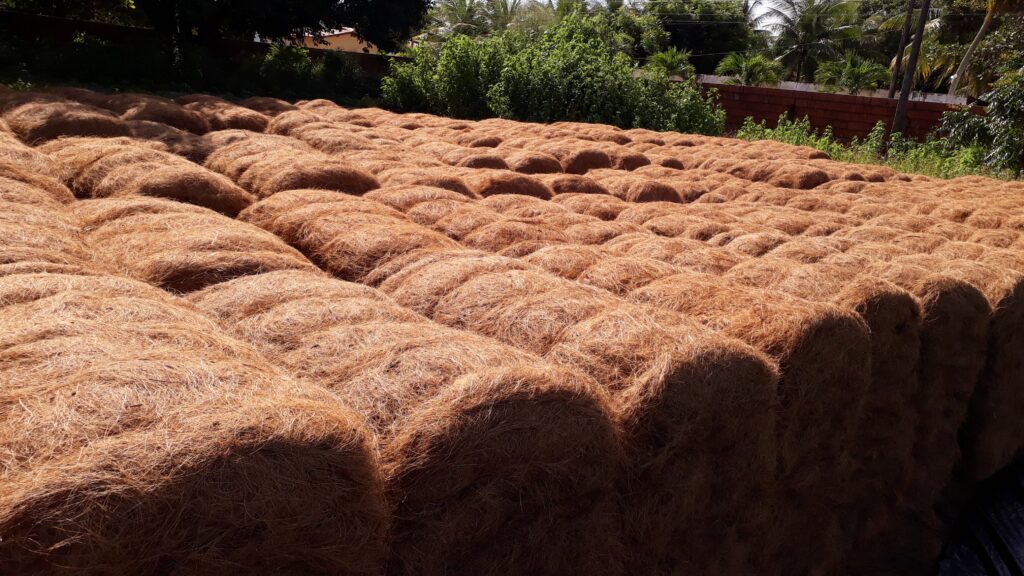
A molded pot line needs coir fibre that is dry, long, low in pith and the same from one lot to the next. Carve Substrates supplies coir fibre for molded pots in pressed bales: brown mesocarp fibre from dry mature coconut husk, 10 to 40 cm long, moisture 18% or less, in the Natural, Washed or Buffered grade, with a report for every lot.
To make molded coir pots, xaxim-style pots or pressed plates, use brown fibre from mature coconuts, dried before it is mixed with the binder. This is the raw material in the KVIC project profile for coir garden pots, which mixes the fibre with natural rubber latex and presses it in a die[1]. Carve supplies this fibre from Brazil: 10 to 40 cm, moisture 18% or less, in pressed bales, Natural for decorative pots or Washed and Buffered when the pot will hold salt-sensitive plants[2].
What a molded pot line needs from the fibre
The problem for a pot maker is not finding coir fibre; it is finding fibre that behaves the same way in the press every month. Fibre that is too wet, full of pith or very different in length from bale to bale forces changes in binder dosing and line settings. These are the points a maker usually fixes with the supplier.
Brown fibre from mature coconuts. The KVIC project profile for coir garden pots (KVIC is the Indian government's rural industries commission) specifies brown coir fibre from ripe coconuts mixed with natural rubber latex[1]. FAO describes brown fibre, from mature coconuts, as stronger than white fibre, which is extracted from green husks after soaking for up to 10 months[3]. Carve fibre is decorticated dry from mature husk: dry mature husk from irrigated groves, never retted in brackish water, EC measured per lot[2].
Dry fibre before mixing. In the same profile, moisture is removed from the fibre before it is mixed with latex[1]. Carve ships at 18% moisture or less, measured on every lot by weighing a sample before and after drying[2][4]. A lower limit can be written into the contract and is then printed on the lot report.
Length. The fibre is 10 to 40 cm, natural length, uncut[2]. That length lets the fibre interlock in the mat that goes into the mould. If your line opens or cuts fibre to a shorter length, that is done at your plant, and the length band and measuring method can be written into the contract.
Low pith. The fibre is the fraction retained on a ~4.1 mm rotary screen, which removes the fine pith[2]. Loose pith left in the fibre does not interlock in the pot wall, so the impurity (pith and dust) limit is agreed per contract and lot data is sent on request.
Consistency from lot to lot. Every lot is bench-tested before dispatch: moisture, bulk density, EC, pH and a visual check against the screen. Lots outside the agreed range do not ship, and the bale QR code opens the lot results[4].
Format. Pressed bales of loose fibre. Export bales weigh 100 to 130 kg and are floor-loaded in a 40' high-cube container without pallets; the full bale specification is sent on request[2].
How fibre becomes a molded pot
The KVIC project profile describes six steps for a latex-bonded coir pot[1]. Carve covers the first one: it delivers fibre ready for final drying and mixing.
- Receiving the fibre: bales are opened before the fibre goes to the line[1].
- Drying: moisture is removed from the fibre before mixing[1].
- Mixing: the fibre is mixed with natural rubber latex to take the shape of the pot[1].
- Pressing: the mixed fibre is placed on the die, where the punch forms the part[1].
- Trimming: loose fibre is trimmed from the edges and corners[1].
- Packing: the pots are packed with care to avoid scratches[1].
Binder, formulation, curing temperature and mould design are the maker's choices. Plates, half-pots and poles follow the same logic of fibre, binder and press, with different moulds.
Which grade to order for pots
A coir pot is a container, but roots grow against its wall. The grade therefore depends on the plant your customer will put in the pot, not on the press. The grade is defined by the process and fixed in the contract; EC is measured and reported on every lot, whatever the grade[2].
| Grade | EC (1:5) | When to use it in pots and plates | Source |
|---|---|---|---|
| Natural | 0.8–1.5 mS/cm | Decorative pots, planters, plates and poles where EC does not matter | [2] |
| Washed | < 0.7 mS/cm | Pots for ornamentals and seedlings, when the pot is sold ready for planting; orchid plates and pots, as the minimum | [2] |
| Buffered | < 0.5 mS/cm | Orchid plates and pots for large-scale production, and other salt-sensitive plants | [2] |
EC measured in a 1:5 (v/v) extract. The acceptance limit for each delivery is the contract limit. See also coir fibre for orchid substrate.
Why natural xaxim left the market in Brazil
In Brazil, molded coir pots are sold as "xaxim de coco". Xaxim is the common name of the tree fern Dicksonia sellowiana, native to the Atlantic Forest, whose fibrous trunk was cut into pots, plates and poles. The species is on Brazil's Official List of Threatened Flora as Endangered (EN), under Ministry of Environment (MMA) Ordinance 148 of 7 June 2022, which amended the annex of MMA Ordinance 443/2014[5].
CONAMA Resolution 278 of 24 May 2001 (Official Gazette, 18 July 2001) instructed IBAMA, the federal environmental agency, to suspend permits for cutting and exploiting threatened plant species in natural populations of the Atlantic Forest[6]. The resolution does not name xaxim; it covers the tree fern because the species is on the official threatened list. CONAMA Resolution 317 of 4 December 2002 regulated Resolution 278[7].
In São Paulo State, Law 11,754 of 1 July 2004 bans the industrial processing and sale of products made directly or indirectly from xaxim extraction, allowing them only for xaxim grown in licensed, registered nurseries[8]. According to the São Paulo Legislative Assembly, the trunk grows five to eight centimetres a year, and it takes almost 50 years to yield a pot 40 to 50 cm in diameter[8].
This section summarises the rules for context and is not legal advice.
Coir fibre specification for molded pots
| Parameter | Carve coir fibre | Source |
|---|---|---|
| Raw material | Mesocarp fibre of the mature dry coconut husk (Cocos nucifera L.) | [2] |
| Fibre class | Brown mixed fibre, loose, not combed; not bristle, not curled, not twisted | [2] |
| Process | Decorticated mechanically; fibre retained on a ~4.1 mm rotary screen; no additives | [2] |
| Length | 10–40 cm, natural length, uncut | [2] |
| Moisture | ≤ 18%, measured on every lot; lower limit by contract | [2][4] |
| Impurities (pith and dust) | Limit agreed per contract; lot data on request | [2] |
| Loose bulk density | ~55–80 kg/m³, actual value per lot | [2] |
| Lignin | High lignin content (literature) | [2] |
| EC (1:5) | Natural 0.8–1.5 · Washed < 0.7 · Buffered < 0.5 mS/cm; measured on every lot | [2] |
| Bale | Pressed bales of loose fibre; export bales 100–130 kg, specification on request | [2] |
| Traceability | Lot number and QR code on every bale, with the lot report | [4] |
Values from the public Carve coir fibre specification. Where a value depends on the lot or the contract, the table says so instead of giving a number.
Numbers with sources
| Indicator | Value | Source |
|---|---|---|
| Threat category of Dicksonia sellowiana (xaxim) in Brazil | Endangered (EN) | [5] |
| CONAMA resolution suspending cutting of threatened Atlantic Forest species | No. 278, 24 May 2001 | [6] |
| São Paulo law banning products from xaxim extraction | No. 11,754, 1 July 2004 | [8] |
| Xaxim trunk growth | 5–8 cm per year | [8] |
| Time for a trunk to yield a 40–50 cm pot | almost 50 years | [8] |
| Soaking time of green husks for white fibre | up to 10 months | [3] |
What this fibre does not do
- It is not a finished pot. Carve supplies the fibre; binder, mould, press, curing and finishing are the maker's.
- It comes without latex or any other binder, and it is not rubberised or curled fibre. It ships loose, in bales.
- It is not combed fibre or fibre sorted into a narrow length band: it is mixed fibre of 10 to 40 cm. If your part needs a narrower band, the measurement and the limit go into the contract.
- It does not replace the growing medium. The coir pot is the container; the substrate inside is a separate product (see coir mix for ornamental pots).
- It has nothing to do with nursery-grown xaxim and is not an origin document for xaxim. It is coir fibre.
How to order coir fibre for your pot line
- Send the part type (pot, half-pot, plate, pole), the binder you use, your monthly volume and the grade (Natural, Washed or Buffered).
- Receive a fibre sample from a production lot, with the report of that lot.
- Test the sample on your press and tell us what needs to change: maximum moisture, pith limit, bale format.
- The contract fixes the grade, the acceptance limits, the bale format and the delivery schedule.
- Every bale ships with a lot number and QR code; a lot outside the contract limit does not ship.
The product page is Coir Fiber; the full data sheet is the coir fibre specification; fibre classes are explained in coir fibre grades; lot testing is on Quality. Other uses of the same fibre: mattress pads, geotextile biomats and doormats.
See all coir pith and coir fibre applications · Contact sales
References
- KVIC, Khadi and Village Industries Commission (Government of India). Project Profile: Coir Garden Pot. PMEGP. KVIC, Project Profile: Coir Garden Pot (PDF)
- Carve Substrates. Coir fibre specification: parameters, grades (EC 1:5 per lot), bales and loading. Carve, coir fibre specification · Carve, Coir Fiber
- FAO, Food and Agriculture Organization of the United Nations. Future Fibres: Coir. FAO, Future Fibres: Coir
- Carve Substrates. Quality: five bench tests per lot, dispatch decision and QR code. Carve, Quality
- Ministério do Meio Ambiente. Portaria MMA nº 148, 7 June 2022, amending the annex of Portaria nº 443/2014 (Official List of Threatened Brazilian Flora). ICMBio, MMA Ordinance 148/2022 (PDF)
- CONAMA. Resolução nº 278, 24 May 2001, on cutting and exploitation of threatened flora species of the Atlantic Forest. DOU nº 138-E, 18 July 2001, Section 1, pp. 51-52. FAOLEX, CONAMA Resolution 278/2001 (PDF)
- CONAMA. Resolução nº 317, 4 December 2002, regulating Resolution 278/2001. DOU nº 245, 19 December 2002, Section 1, p. 224. FAOLEX, CONAMA Resolution 317/2002 (PDF)
- Assembleia Legislativa do Estado de São Paulo. Ameaçado de extinção, o xaxim tem sua industrialização e comercialização proibida há dez anos (on State Law 11,754/2004). ALESP, 2 October 2014. ALESP, news item of 2 October 2014
Questions about coir fibre for molded pots
What kind of coir fibre is used to make molded coir pots?
Brown fibre from mature coconuts, dried before it is mixed with the binder. The KVIC project profile for coir garden pots describes brown coir fibre mixed with natural rubber latex and pressed in a die. Carve fibre is of this type: brown, from dry mature husk, 10 to 40 cm long, moisture 18% or less.
Does fibre for pots need to be washed?
It depends on the plant that will grow in the pot. For decorative pots, planters and uses where EC does not matter, the Natural grade works. For pots sold for ornamentals, use Washed (EC below 0.7 mS/cm); for orchid plates and pots, Washed as the minimum and Buffered (below 0.5 mS/cm) for large-scale production. EC is measured on every lot.
What is xaxim, and why was it replaced by coir?
Xaxim is the Brazilian name for the trunk of the tree fern Dicksonia sellowiana, once cut into pots and plates. The species is listed as Endangered (EN) on Brazil's official list of threatened flora (MMA Ordinance 148/2022). CONAMA Resolution 278/2001 suspended cutting permits for threatened species in the Atlantic Forest, and São Paulo State Law 11,754/2004 bans making and selling products from xaxim extraction, except from licensed nurseries. Coir pots took over the category.
How is the fibre packed and shipped?
As pressed bales of loose fibre with a lot number and QR code. Export bales weigh 100 to 130 kg and are floor-loaded in a 40' high-cube container, FOB Pecém; the full bale specification is sent on request.
Does Carve sell finished coir pots?
No. Carve supplies the fibre as a raw material. Binder, moulds, pressing, curing and finishing are done by the pot maker.
How do I get a sample to test on my press?
Send the part type, the binder you use, your monthly volume and the grade to WhatsApp +55 11 99131-9577 or comercial@carvebio.com.br. The sample comes from a production lot, with its lot report.
Request a sample
Get a coir fibre sample from a production lot, with its lot report, to test on your pot line.