Coconut Husk Chips for Orchids and Epiphytes
Husk chips — cut pieces of dry mature coconut husk with controlled dimensions — carry the lowest water retention and highest aeration of any coir product, an estimated ~200 ml/L against several times that for coir pith, which matches the drainage-first root habit of orchids, bromeliads and other epiphytes [1]. Carve's chips line is currently in development at the Paraipaba-CE plant; the specifications below are indicative, drawn from the raw dry-husk material and the process design, and will be confirmed with per-lot bench testing once production begins [2].
The agronomic and physical case
Orchids and most epiphytic ornamentals evolved with roots exposed to open air on tree bark or rock, wetting quickly after rain and drying out just as fast — a physical environment that a saturated, fine-particle substrate cannot reproduce. Chips answer this directly: the coarse, cut pieces of dry husk leave large air gaps between particles, producing an estimated total porosity above 90% and the lowest water-holding figure among coir products (~200 ml/L versus several times that for pith), so roots are surrounded by moving air between waterings rather than sitting in a wet, low-oxygen zone [1][3].
Because orchid roots are also unusually sensitive to salt build-up — professional Phalaenopsis growers document root-tip necrosis from potassium and sodium exposure at levels many other crops tolerate — the starting EC of the raw material matters more here than in almost any other coir application [4]. This is where origin becomes a specification question rather than a marketing point: husk that has never sat in a retting pond starts from a materially lower salt baseline than husk that has, before any washing step is even applied.
Technical specification — in development, indicative
Husk chips are in development at Carve's plant. The values below are indicative estimates based on raw material and process design, not yet confirmed by per-lot bench testing. Final specifications will be measured and printed per lot, with a QR code on every bag linking to the full report, once production starts.
| Parameter | Carve Husk Chips — Orchid/epiphyte grade (indicative) |
|---|---|
| Raw material | Dry mature coconut husk (Cocos nucifera L.), Ceará coast, dry-farmed groves, never retted |
| Process | Mechanical cutting to controlled particle dimensions; Natural, Washed and Buffered grades planned |
| Particle size | Controlled-dimension cut pieces; grade sizing to be confirmed with orchid-segment buyers |
| EC (1:5 v/v) | Natural grade estimated 0.8-1.5 mS/cm; do not exceed 1.5 mS/cm for orchid/epiphyte use; Washed and Buffered grades planned for salt-sensitive genera |
| pH | To be measured per lot; raw dry-husk literature range 4.9-6.0 |
| Water retention | Estimated ~200 ml/L — the lowest among coir products, for maximum aeration |
| Total porosity | Estimated >90% |
| Bulk density | To be confirmed; expected lower than pith or fiber due to coarse particle structure |
| Organic matter | Literature reference 91-95% for coir products generally; to be confirmed for chips |
| Packaging | Woven bag, format to be confirmed; lot QR code planned for filmed bench test + origin data |
| Chemistry context | K 1.60%, Cl 1.80%, Na 0.38% dry mass in the raw husk; theoretical EC ceiling of raw material 1.0-1.5 mS/cm before any washing [5] |
In development
Contact us to be notified when husk chips samples and lot testing become available.
Step by step
- Confirm the EC of the lot you receive is at or below 1.5 mS/cm (1:5 extract) before potting salt-sensitive genera such as Phalaenopsis; request Washed or Buffered grade rather than Natural for these crops once available.
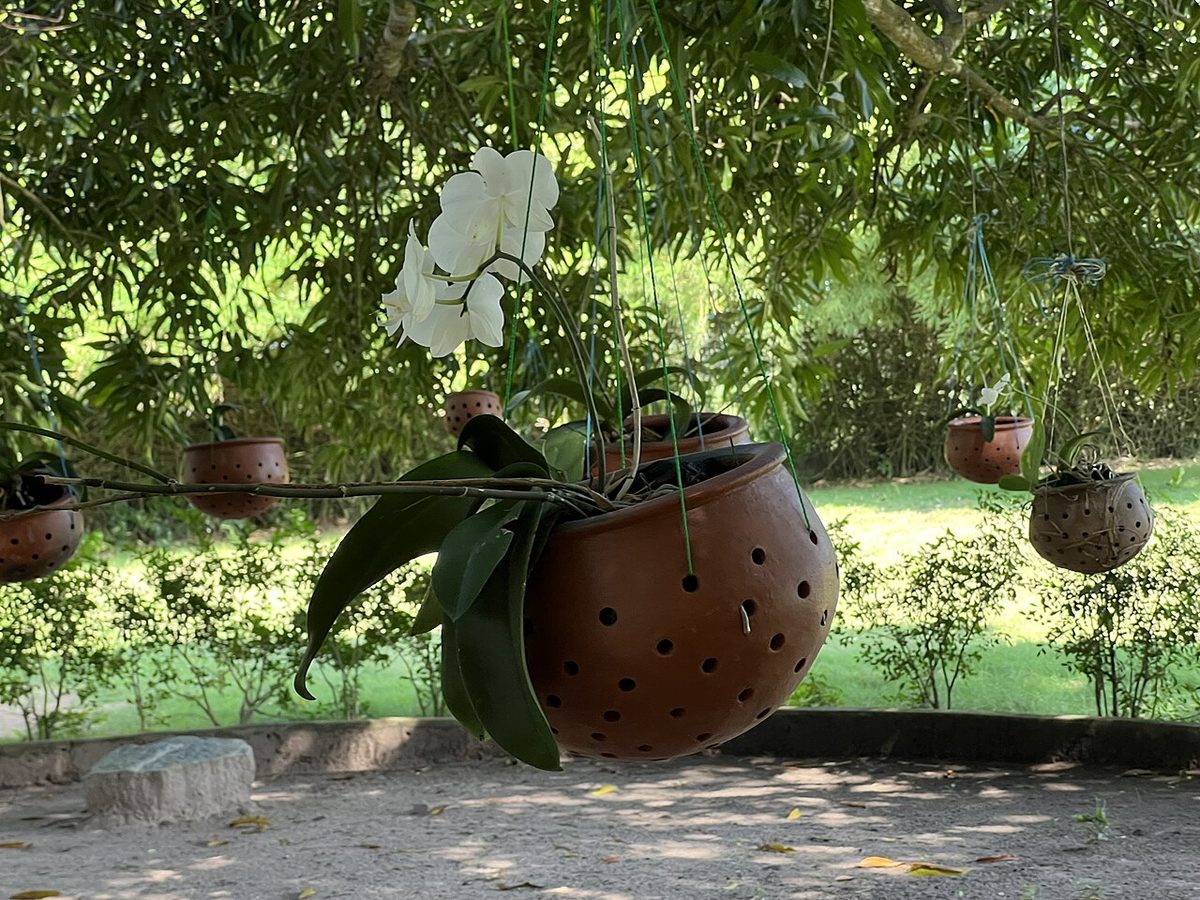
- Pot loosely in open baskets, clay pots with large drainage holes, or mounted directly to bark or cork — chips are designed for maximum airflow, so a tightly packed or closed container defeats the purpose.
- Blend with coir pith, bark, perlite or sphagnum if your program needs more moisture retention than pure chips provide — many growers run chips as the coarse fraction of a formulated epiphyte mix rather than as a 100% standalone medium.
- Water more frequently than with pith or a soil-based mix, since chips dry rapidly by design; irrigation frequency, not media choice, is the main lever for matching moisture to a given greenhouse's humidity level.
- Fertigate at a diluted, more frequent rate consistent with orchid feeding programs; a low-EC starting substrate lets you control the full nutrient input without an unknown contribution from the media.
- Inspect root tips periodically for browning or necrosis, the visible sign of salt stress in orchids, and treat any sign as a trigger to leach the media and review the water source's own mineral load.
- Expect a shorter media-replacement interval than for pith-based substrates, since coarse chips break down and compact over time in humid greenhouse conditions.
The data behind this application
- ~200 ml/Lestimated water retention of husk chips — the lowest among coir products, for maximum aeration [1].
- >90%estimated total porosity of husk chips [3].
- ≤1.5 mS/cmrecommended EC ceiling (1:5 extract) for chips used in orchid and epiphyte growing [4].
- 0.8-1.5 mS/cmestimated EC (1:5) of Carve's Natural-grade chips, before washing or buffering [5].
- 1.0-1.5 mS/cmtheoretical maximum EC (1:5) of Carve's raw composition before any washing [5].
- In developmentcurrent status of Carve's chips line at the Paraipaba-CE plant [2].
What this product does not do
Husk chips are in development, so every figure on this page is an indicative estimate rather than a per-lot guarantee; buyers with a near-term order should confirm current status before specifying chips into a program. Even once in production, chips' defining feature — low retention and high aeration — is a limitation in its own right for any crop or climate that needs sustained moisture: chips are not a substitute for coir pith or a retentive blend in dry greenhouses, small pots, or fast-draining conditions that outrun a grower's irrigation frequency. Coarse chips also compact and break down faster than pith under repeated wetting, which typically means a shorter media-replacement cycle in continuous greenhouse production. And while Carve's never-retted origin lowers the starting salt baseline relative to typical Asian retted coir, it does not eliminate the need for washing or buffering on the most salt-sensitive genera such as Phalaenopsis [4].
Carve's product for this application
Carve's Husk Chips line, currently in development at the Paraipaba-CE plant, is cut from dry mature coconut husk grown in irrigated coconut groves on the Ceará coast — never retted in brackish or tidal water, and irrigated with low-conductivity well water. This stands in direct contrast to the retting process behind much of the coir chips sold internationally, where husks are soaked in ponds, lagoons or tidal water to loosen fiber for extraction, adding sodium and chloride loading beyond the coconut's inherent chemistry and carrying a documented risk of residual pathogens from the retting water. Carve's own composition data (K 1.60%, Na 0.38%, Cl 1.80% dry mass) puts the theoretical EC ceiling of the raw material at just 1.0-1.5 mS/cm even before any washing step — a lower, more predictable starting point for a Washed or Buffered chips grade once production is confirmed [5]. Buyers interested in orchid and epiphyte chips are encouraged to make contact now to be notified when samples and lot testing become available. For related applications see /en/products/coir-fiber-orchid-substrate; for the current product line see /en/products/coir-pith, /en/products/coir-fiber and /en/products/coir-mix; for export questions see /en/import-coir-from-brazil.
References
- [1] Carve internal research, `coir-products-use-cases-grades-2026-09-01.md` — chips water retention (~200 ml/L) and aeration profile relative to other coir products.
- [2] Carve internal status, `state/missions.md` §Product line — husk chips in development, Paraipaba-CE plant.
- [3] Raviv, M. & Lieth, J.H. (eds.), Soilless Culture: Theory and Practice, 2nd ed., Table 8.5, p. 317 — total porosity across coir origins, applied here as an estimate for coarse chip structure.
- [4] Carve internal research, `coir-products-use-cases-grades-2026-09-01.md` §3.1/§3.3 — orchid root-tip necrosis from K/Na, professional-grower buffering requirement, recommended EC ceiling for epiphyte use.
- [5] Carve internal composition analysis (EMBRAPA Tabela 1, Tabuleiros Costeiros 2005) — K 1.60%, Na 0.38%, Cl 1.80%; theoretical EC ceiling, `mvp-product-specs.md` §2.
Frequently asked questions
Why are husk chips good for orchids and epiphytes?
Chips are cut pieces of dry mature coconut husk with large air gaps between particles, giving the lowest water retention and highest aeration of any coir product — roughly 200 ml/L compared to several times that for pith. That combination of rapid drainage and constant airflow around the roots matches the epiphytic growth habit of orchids and bromeliads, whose roots are adapted to intermittent wetting and drying in the open air rather than a saturated soil profile [1].
Is Carve's husk chips product available now?
Husk chips are in development at Carve's plant in Paraipaba-CE. The specifications on this page are indicative, based on the raw material and process design, and will be confirmed with per-lot bench testing once production starts. Contact us to be notified when samples are available [2].
What EC should chips be for orchid growing?
For orchid and epiphyte use, an EC at or below 1.5 mS/cm (1:5 extract) is the ceiling worth specifying, with Washed or Buffered grade preferred over Natural for the most salt-sensitive genera such as Phalaenopsis. Natural-grade chips from Carve's never-retted dry husk are estimated at 0.8-1.5 mS/cm before any washing step [4][5].
How is coconut husk chips different from Asian retted coir chips for orchids?
Most coir chips sold internationally come from husk retted in ponds, lagoons or tidal water to loosen the fiber, a process that adds sodium and chloride loading beyond the coconut's own chemistry and can leave residual pathogens from the retting water. Carve's husk is dry-farmed on the Ceará coast and never retted, which gives chips a lower and more predictable starting salt baseline before any washing or buffering [5].
Can husk chips be mixed with other substrates for orchids?
Yes — chips are commonly blended with coir pith, bark, perlite or sphagnum moss to fine-tune the balance between aeration and moisture retention for a given genus, pot size and greenhouse humidity level, rather than used as a 100% standalone medium in every program.
Request a sample
Get in touch to be notified when husk chips samples and complete technical data become available.