Coir producers in Brazil
Carve is a coconut coir manufacturer in Paraipaba, Ceará, Northeast Brazil. We produce coir pith, coir fiber, coir mix and husk chips from mature dry coconut husk — batch-tested, QR-traceable, direct from the factory.
Brazil's coconut coir industry
Brazil is one of the world's largest coconut producers, harvesting approximately 2.3 billion coconuts per year (FAO). The state of Ceará leads national production with over 520 million fruits annually (IBGE, PAM 2023), and the municipality of Paraipaba has ranked among the top coconut-producing municipalities in the country for several consecutive years.
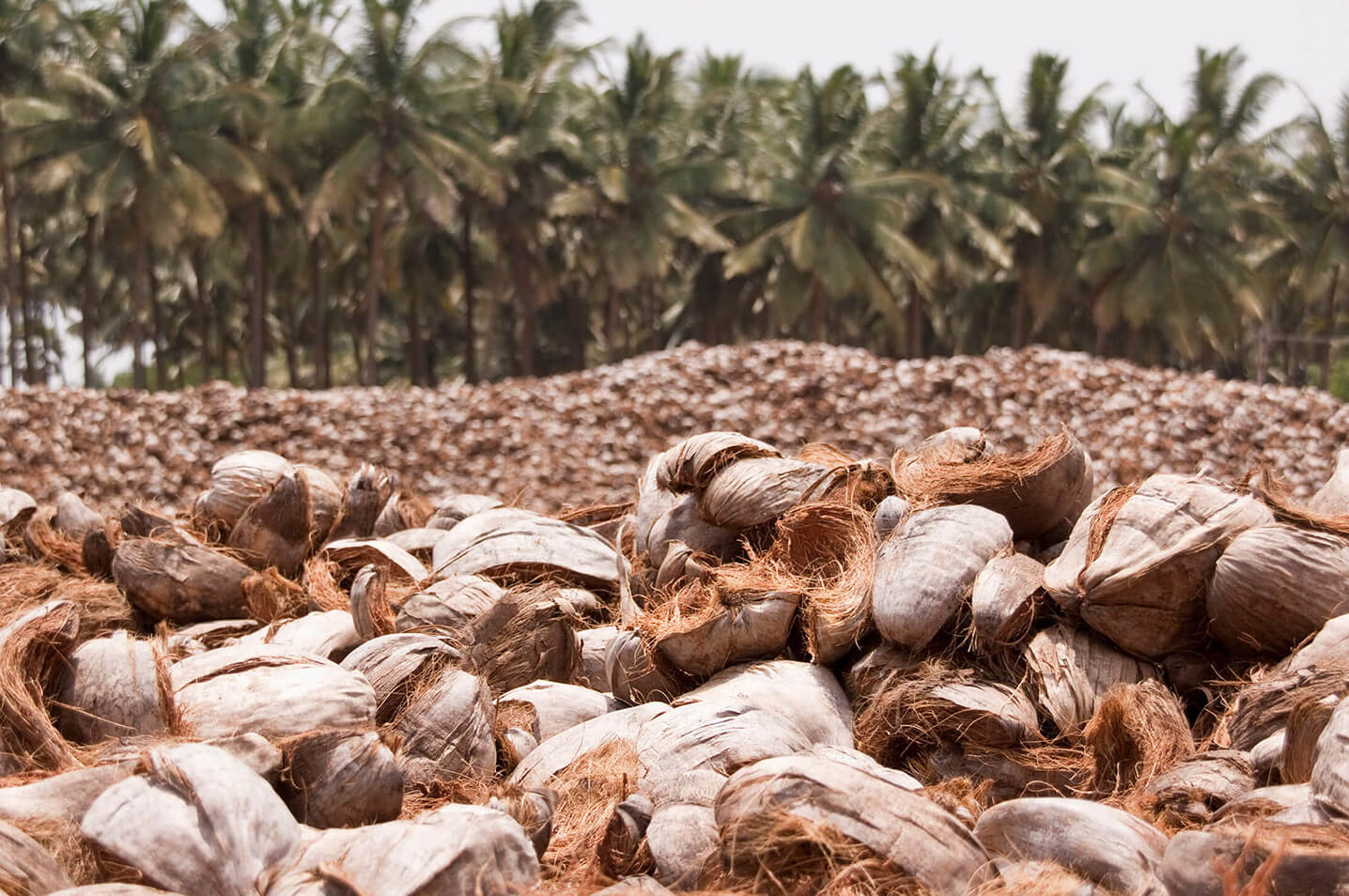
For decades, coconut husk was treated as agricultural waste. A growing shift is now underway: processors in Northeast Brazil are turning dry husk into high-value coir pith and coir fiber for substrates, horticulture, erosion control and industrial applications. Brazilian coir from mature dry husk that was never retted in brackish water carries less sodium than most Asian coir, requiring fewer wash cycles to reach low EC levels.
Carve operates at the centre of this production belt, in Paraipaba, Ceará, processing dry coconut husk into coir products for the domestic and export markets.
Coconuts harvested per year in Brazil. Ceará alone produces over 520 million fruits annually (IBGE, PAM 2023).
Coir products from Brazil
Carve manufactures four product lines from mature dry coconut husk. All products are available in natural, washed or buffered grades.
Fine fraction of the coconut husk, approximately 60% of the dry husk by weight. Used as a growing medium for seedlings, vegetables, flowers and ornamental plants. Compressed 5 kg blocks or bags.
View specificationsLong bristle fiber mechanically extracted from dry husk, approximately 28% of the husk by weight. Used in substrates, geotextiles, erosion-control blankets, mattress pads and composites. Baled.
View specificationsBlend of coir pith and short fiber in a ratio defined with the buyer. Designed for potting mixes, container growing, landscaping and green-roof substrates.
View specificationsHusk chips cut from whole coconut shell, 10–20 mm. Used for orchid substrates, blueberry growing, drainage layers and decorative mulch.
View specificationsWhy source coir from Carve
Direct from the manufacturer in Paraipaba, Ceará, with no trading intermediary.
Every lot is bench-tested before dispatch: EC, pH, moisture, bulk density and particle size. Natural, washed (EC < 0.7 mS/cm) or buffered (EC < 0.5 mS/cm) grades available.
Each bag carries a QR code linking to the lot analysis report. Full traceability from raw husk to finished product.
Raw material is mature dry coconut husk from inland farms in Ceará, never retted in brackish water. The result is lower starting sodium, fewer wash cycles and cleaner end product.
Entirely mechanical process: shredding and rotary screening. No chemicals, no additives. Washing and buffering use freshwater from an artesian well.
Compressed 5 kg blocks (30 × 30 × 14 cm, ≥ 65 L per block), bales and bulk bags. Phytosanitary certificate (MAPA), certificate of origin, ISPM-15 pallets.
Shipments leave from the Port of Pecém, Ceará — a competitive Atlantic route to Europe, the Americas and the Middle East, without Suez Canal or Cape of Good Hope passages.
Shipping coir from Brazil
Carve ships from the Port of Pecém (APM Terminals), located in Ceará, approximately 100 km from the plant. Pecém offers weekly direct services to Northern Europe, the US East Coast and the Mediterranean, with transit times as short as six days to New York and two weeks to Northern Europe.
Quotations are FOB Pecém per 40' high-cube container. CFR and CIF terms are available on request through our freight forwarder. Products are loaded on ISPM-15 certified pallets with phytosanitary certificate issued by MAPA (Brazil's agriculture ministry).
Coir (HS 5305) enters the USA, Canada, UK, Japan and Australia duty-free. The EU applies 0% on this tariff line.
Contact the manufacturer
Talk to our sales team for technical data sheets, pricing and export terms. Direct from the factory in Ceará, Brazil.