01 · Summary.
Carve supplies brown coir fibre of the mixed/mattress type: fibre decorticated from the mature dry coconut husk, separated from the pith on a rotary screen, 10 to 40 cm long, loose and not combed, pressed into bales. The same product is called coir fibre, coir fiber, coconut fibre or brown coir fibre in the trade. Every lot is tested before dispatch, and the results go on the lot report that the bale QR code opens.[1][2]
02 · Parameter table.
| Parameter | Carve coir fibre | Note |
|---|---|---|
| Fibre class | Brown coir fibre, mixed/mattress type | Loose, unsorted by length. Not bristle, not curled, not twisted |
| Raw material | Mesocarp fibre of the mature dry coconut husk (Cocos nucifera L.) | Dry mature husk, never retted in brackish water |
| Process | Decorticated mechanically; fibre retained on a rotary screen, ~4.1 mm mesh | Not combed. No chemicals, no additives |
| Length | 10–40 cm | Natural length, uncut |
| Moisture | ≤ 18 % | Measured per lot (mass before and after drying) |
| Impurities (pith and dust) | Impurity limit agreed per contract; lot data on request | Pith and dust content |
| Loose bulk density | ~55–80 kg/m³ | Actual value per lot |
| Lignin | 35–45 % | Literature value for coir fibre |
| Colour | Brown | Fibre from mature husk |
| EC and pH (1:5) | Measured per lot | Relevant only when the fibre goes into growing media |
| Grades | Natural · Washed · Buffered | Natural is the usual grade for industrial use |
| Bale | Pressed bales of loose fibre. Export bales: 100–130 kg, specification on request | Bale weights listed per lot on the packing list |
| Container loading | Floor-loaded 40' HC, no pallets | Net tonnes per container confirmed with the export bale specification |
| HS code | 5305.00 (Brazil NCM 5305.00.90) | Coir, raw or processed but not spun |
| Origin | Paraipaba, Ceará, Brazil | Shipped from the Port of Pecém |
Values: Carve public data sheet.[1] Lignin is a literature value for coir fibre and is confirmed by an external laboratory before it is used in a contract.
03 · How each value is measured.
| Parameter | Method | When |
|---|---|---|
| Moisture | Mass of a sample before and after drying | Every lot |
| Bulk density | Mass over volume of a loose sample | Every lot |
| Length and screen fraction | Visual inspection against the 10–40 cm band and the ~4.1 mm screen | Every lot |
| EC | 1:5 extract (v/v) | Every lot |
| pH | 1:5 extract | Every lot |
| Impurities (pith, dust) | Limit and method agreed per contract | Lot data on request |
| Lignin, organic matter, minerals | External laboratory panel | Periodically |
Bench tests as described on the Quality page.[2] Buyers who specify length fractions (for example, the share of fibre shorter than 30 mm) agree the method and the limit in the contract.
04 · Bales, loading and labels.
- Export bales: 100–130 kg of loose fibre, pressed and strapped. The full bale specification (dimensions, strapping, weight tolerance) is sent on request.
- Domestic bales: pressed bales of loose fibre, weight and volume on request.
- Loading: floor-loaded in a 40' high-cube container, without pallets, so no ISPM 15 wood treatment is involved. Net tonnes per container are confirmed with the export bale specification before the quotation.
- Labels: each bale carries the lot number and a QR code that opens the lot results. The packing list gives the bale count and the gross and net weights.
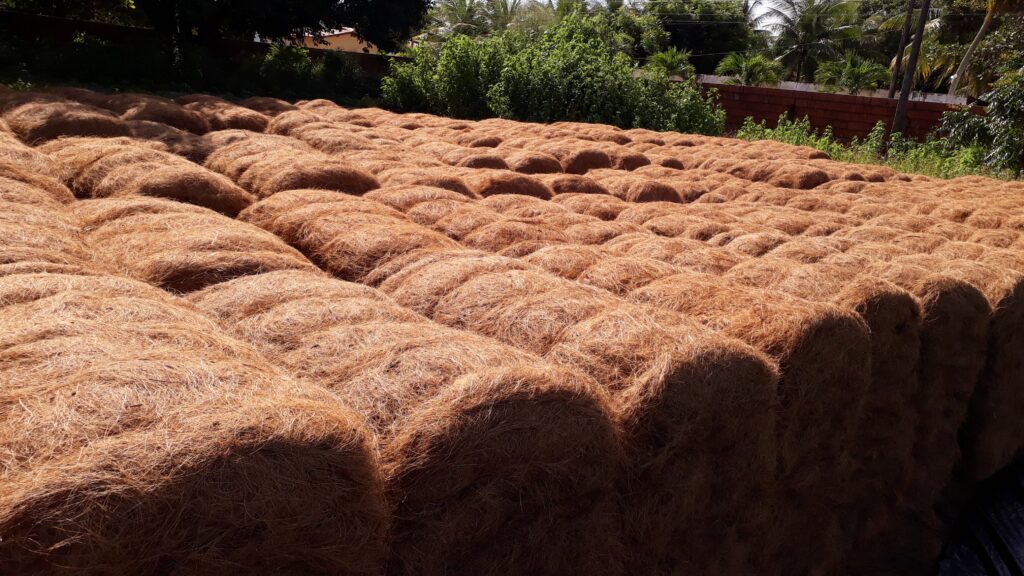
05 · Lot report and QR code.
Every lot is tested before dispatch. The lot report gives moisture, bulk density, EC and pH and the lot date (impurity data on request), and the QR code on the bale opens the same record. Lots outside the agreed range are held back and do not ship.[2] An example lot report is sent with the offer.
06 · What this fibre is not.
- Not bristle fibre. Bristle is the longest fibre, combed and sorted for brushes and brooms. Carve fibre is raw and not suited to brushes, brooms or handicrafts.[1][3]
- Not curled or twisted fibre. Carve ships loose baled fibre. Curling or twisting into rope is done by the converter.
- Not white fibre. White fibre comes from green husks retted in water, mainly for yarn and rope. Carve fibre is brown, from mature dry husk.[3]
The grade names are explained in Coir fibre grades: bristle, mattress, mixed, twisted and white.
07 · Trade terms and documents.
| Item | Carve practice |
|---|---|
| Incoterm | FOB Port of Pecém, Ceará. CFR on request through our forwarder. |
| Commercial documents | Commercial invoice, packing list (bale count, gross and net weight), bill of lading |
| Certificate of origin | Issued in Ceará by the state industry federation's international centre[6] |
| Phytosanitary certificate | Issued by MAPA, Brazil's Ministry of Agriculture, when the destination requires it or the buyer asks for it[5] |
| Fumigation certificate | When the destination requires it |
| Lot report | With every shipment; QR code on every bale |
| Samples | Loose fibre from a production lot, sent by courier with its lot report. Quantity and courier terms agreed on request |
Transit times from Pecém to ports in the Americas and Europe are on Coir fibre for buyers in the Americas.
08 · Frequently asked questions.
Is this bristle coir fibre?
No. It is brown mixed fibre of the mattress type: decorticated from dry mature husk, 10 to 40 cm, loose and not combed. Bristle fibre is combed and sorted by length for brushes; Carve does not supply it.
What moisture does the fibre ship at?
The guaranteed maximum is 18 %, measured on every lot by weighing a sample before and after drying. A lower contractual limit can be agreed per order and is then printed on the lot report.
What is the impurity (pith and dust) content?
The impurity limit is agreed per contract with the buyer before the order; lot data on request.
How heavy are the bales, and how many tonnes fit in a 40' HC?
Export bales weigh 100 to 130 kg; the full bale specification is sent on request. Net tonnes per 40' HC depend on the bale density and are confirmed with that specification before any quotation. Carve does not publish a container figure until it is measured on its own export bales.
Can I get a printable specification?
Yes. This page prints as a specification sheet from the browser (File, Print). An example lot report is sent with every offer.
09 · Sources.
- Carve public data sheet, Coir Fiber and Fibra de Coco: length 10–40 cm, moisture ≤18 %, loose density ~55–80 kg/m³, lignin 35–45 %, raw uncombed fibre, pressed bales.
- Carve, Quality and lot report: bench tests per lot (EC 1:5 v/v, pH 1:5, moisture, bulk density, screen fraction), external laboratory panel, lots outside the range held back.
- Wikipedia, "Coir": brown fibre from mature husks and white fibre from green husks; bristle and mattress fibre. en.wikipedia.org/wiki/Coir.
- APM Terminals Pecém: shipping lines and services calling Pecém.
- MAPA, phytosanitary requirements and certification for plant exports: gov.br/agricultura.
- CIN-CE (FIEC), certificate of origin: cin-ce.org.br.