What can go wrong in a gutter
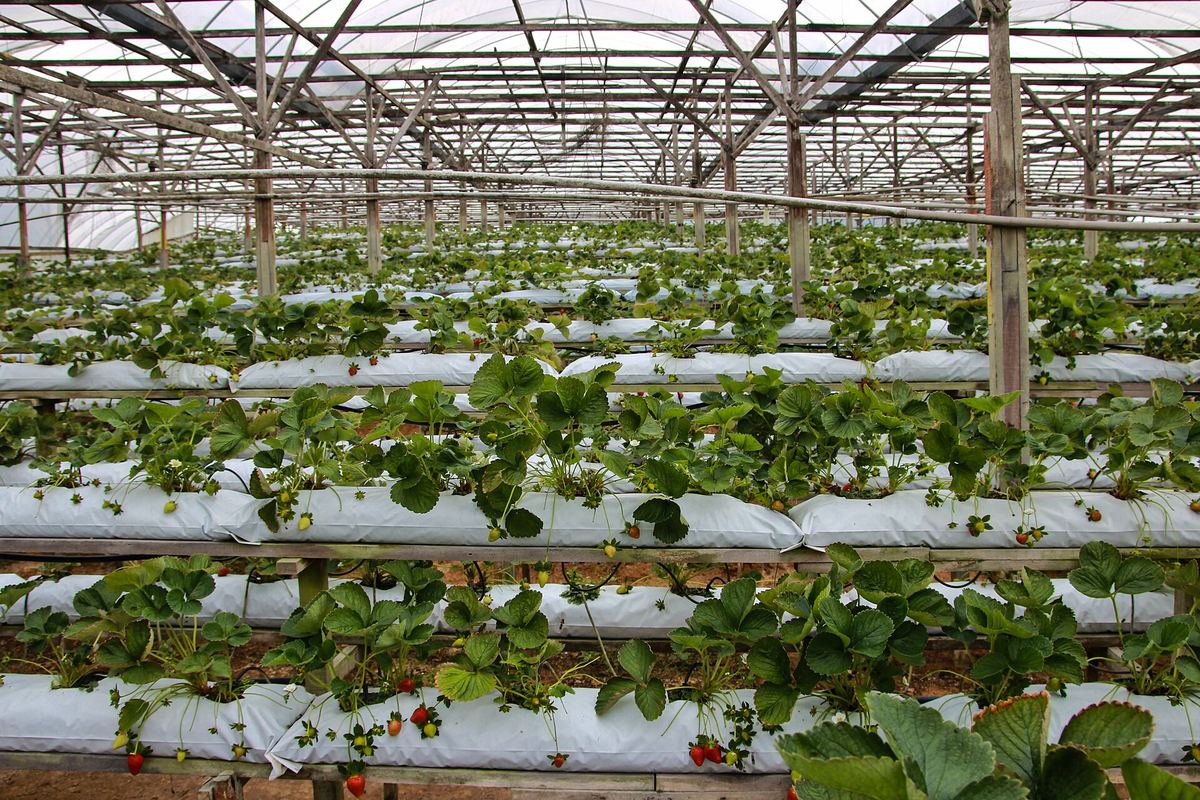
In a gutter, trough or slab, each plant has little substrate. In the semi-hydroponic strawberry system described by Embrapa Grape and Wine, it is about 2 L of substrate per plant[2]; a Colombian reference gives 1.5 to 2.5 L[3]. With so little volume, three problems show up fast:
- Salt at the root. Any salt the substrate releases reaches the root zone quickly. Strawberry has one of the lowest salinity thresholds in the FAO table, below lettuce, grape, orange and cucumber[1].
- Waterlogging. A substrate that holds too much water leaves little air between irrigations, above all at the bottom of the gutter.
- A lot that differs from the last one. If EC and moisture change from one load to the next, a fertigation recipe set for the previous load stops fitting.
Why washed fibre
Coconut husk holds sodium and potassium in two fractions. The soluble fraction leaves with a freshwater wash. The fraction held on the fibre's exchange sites only moves when calcium or magnesium displaces it[3]. Hence Carve's three grades, all for sale:
| Grade | Process | Lot EC (1:5) | Use in gutters and slabs |
|---|---|---|---|
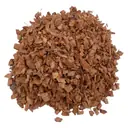
| Natural | Decortication and screening, no washing | 0.8–1.5 mS/cm | Blends whose formulation corrects EC; tolerant crops |
| Washed | Freshwater washing | < 0.7 mS/cm | Minimum for tomato, cucumber and leafy crops |
| Buffered | Washing, then calcium treatment | < 0.5 mS/cm | Strawberry and salt-sensitive crops |
EC bands from the Carve specification, measured in a 1:5 extract and printed on every lot report[4].
In a substrate that is only washed, the calcium and magnesium in the nutrient solution displace the retained sodium and potassium, which then move into the root zone[3]. For tomato and leafy crops, the Washed grade is the starting point. For strawberry, Carve recommends the Buffered grade.
Carve coir fiber comes from dry mature husk from irrigated groves, never retted in brackish water, processed with low-conductivity well water, with EC measured per lot.
Fibre, pith or mix in the gutter
Choosing between fibre, pith and a mix is choosing between retained water and air. Carve's three products come from the same dry coconut husk and differ in fraction:
| Product | What it is | Water holding | Behaviour in the gutter |
|---|---|---|---|
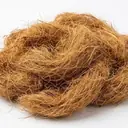
| Coir Fiber | Raw fibre, 10–40 cm, not combed | ~300 ml/L | More air, faster drainage; shorter, more frequent irrigations |
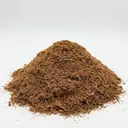
| Coir Mix | Pith and fibre in a ratio set by the customer | ~400 ml/L | In between; the ratio sets air and water |
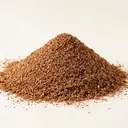
| Coir Pith | Fine fraction screened at ~4.13 mm mesh | ~500 ml/L | Most water held; in small volumes it needs a drainage component |
Reference values from the Carve specification[4]. Total porosity of dry coconut husk pith above 94%[5].
Pure pith holds a lot of water, and in small containers the practice cited for strawberry is to blend it with a drainage component such as rice husk[3]; the Embrapa system works with carbonised rice husk and substrate blends[2]. Fibre does the opposite: it adds air and drainage. Coarser fractions also last longer: the reference durability of medium-grade fibre in substrate is 4 to 7 years in continuous cropping, against 1.5 to 2 years for fine pith[3].
In practice the choice depends on the crop, the width and depth of the gutter, irrigation frequency and the water available. Set the blend with your agronomist; Carve supplies fibre, Coir Mix in the ratio you ask for, or coir pith, in the same grade (Natural, Washed or Buffered).
How to specify the lot
Put these parameters in the order and check them on the report for every load:
| Parameter | What to ask for | Carve reference |
|---|---|---|
| Grade and EC (1:5) | Acceptable EC band for the crop | Washed < 0.7 mS/cm · Buffered < 0.5 mS/cm[4] |
| Fraction | Fibre, pith or Coir Mix; for the mix, the ratio | Fibre 10–40 cm · pith ~4.13 mm mesh[4] |
| Moisture | Maximum moisture at dispatch | ≤ 18%[4] |
| pH | Value reported per lot | Measured per lot[4] |
| Loose bulk density | Lot value, to convert kg to litres | Measured per lot[4] |
| Format | Bale (fibre) or 100 L sack (pith and Coir Mix) | Minimum order for fibre and Coir Mix: 1 t[4] |
On arrival, measure the EC of the drainage after the first irrigation with nutrient solution. How each lot is tested: Quality and lot report. Full fibre parameters: coir fibre specification.
How much substrate per metre of gutter
Volume depends on your gutter's cross-section, so the sum is yours. Measure the inside width and the fill depth, in centimetres:
Total litres = litres per metre × metres of gutter × k
k is the settling factor: how much loose substrate you need for the gutter to stay full once settled and wet. Measure it on a 1 m test length: k = litres of loose substrate used ÷ litres per metre of the gutter.
To convert to weight (fibre is sold in bales, by the kilogram):
100 L sacks (pith or Coir Mix) = total litres ÷ 100
In grow bags or slabs, start from the plant: litres per plant × number of plants. For strawberry, the Embrapa reference is about 2 L per plant, in bags of about 8 L with four plants[2].
Fill in the fields with your gutter's measurements.
Delivery format
Coir fibre is delivered in bales of loose fibre, pressed for transport; Coir Mix and coir pith in 100 L sacks. Every lot leaves with a report of EC, pH, moisture and bulk density[4]. In Brazil the minimum order for fibre and Coir Mix is 1 tonne; export orders ship as one 40' HC, FOB Pecém. A sample from a production lot is available for testing. When you open a bale, tease the fibre apart before filling the gutter, to get the air volume back.
See the full specification on Coir Fiber, the pith-based route on coir pith for tomato substrate, and market prices on coir fibre price in Brazil.
Frequently asked questions
Can I fill a gutter with coir fibre alone?
Yes, when the crop and the irrigation regime call for a lot of air and fast drainage. Coir fibre holds about 300 ml of water per litre, against about 500 ml/L for fine coir pith, so it drains faster and needs shorter, more frequent irrigations. For crops that need more available water between irrigations, a fibre and pith blend (Coir Mix, ratio set by the customer) sits in between, at about 400 ml/L.
For strawberry, washed or buffered coir fiber?
Strawberry is among the least salt-tolerant crops in the FAO table. Washing removes soluble salts but does not displace the sodium and potassium held on the coir's exchange sites; buffering with calcium does. That is why Carve recommends the Buffered grade for strawberry (EC 1:5 below 0.5 mS/cm). For tomato and leafy crops, the Washed grade (EC below 0.7 mS/cm) is the minimum.
How many litres of substrate go in one metre of gutter?
It depends on your gutter's cross-section. Litres per metre = inside width (cm) × fill depth (cm) × 0.1. Multiply by the metres of gutter and by a settling factor you measure by filling a 1 m test length. For strawberry in grow bags, Embrapa Grape and Wine uses about 2 L of substrate per plant.
What is the EC of washed coir fibre?
At Carve, the Washed grade has an EC (1:5) below 0.7 mS/cm and the Buffered grade below 0.5 mS/cm. The Natural grade sits between 0.8 and 1.5 mS/cm. EC is measured on every lot and printed on the lot report.
How is the coir fibre delivered?
Coir fibre comes in bales pressed for transport, with the lot report. Coir Mix and coir pith come in 100 L sacks. In Brazil the minimum order for fibre and Coir Mix is 1 tonne; export orders ship as one 40' HC.
How long does coir fibre last in a gutter?
Coarser fractions last longer. The reference durability of medium-grade fibre in substrate is 4 to 7 years in continuous cropping, against 1.5 to 2 years for fine pith. Check the substrate structure at the end of every crop cycle.
Sources
- Ayers, R.S.; Westcot, D.W. (1985). Water quality for agriculture. FAO Irrigation and Drainage Paper 29 Rev.1, Table 4: crop salt tolerance — fao.org/4/t0234e/t0234e00.htm
- Bortolozzo, A.R. et al. (2007). Produção de morangos no sistema semi-hidropônico (strawberry production in the semi-hydroponic system). Circular Técnica 62, Embrapa Uva e Vinho (Embrapa Grape and Wine), Bento Gonçalves — infoteca.cnptia.embrapa.br
- Romero, A. (2025). Webinar "El Coco como Sustrato", Colombia: litres of substrate per plant, salts in two fractions (soluble and retained), displacement by calcium or magnesium, blending with rice husk, durability by particle size.
- Carve product specification published on carvebio.com.br: Coir Fiber (length 10–40 cm, moisture ≤18%, water holding ~300 ml/L, total porosity >94%, pressed bales); Coir Mix (~400 ml/L, ratio set by the customer); Coir Pith (~500 ml/L, ~4.13 mm mesh, 100 L sack); grades Natural (EC 0.8–1.5 mS/cm, 1:5), Washed (< 0.7) and Buffered (< 0.5), EC measured per lot — /en/coir-fiber/specification.
- EMBRAPA Tabuleiros Costeiros, Comunicado Técnico 226: characterisation of dry coconut husk pith (total porosity, water holding).
Page maintained by the Carve technical team. Figures are reproduced as published by the sources cited. Corrections and further sources: [email protected].