01 · What Carve supplies.
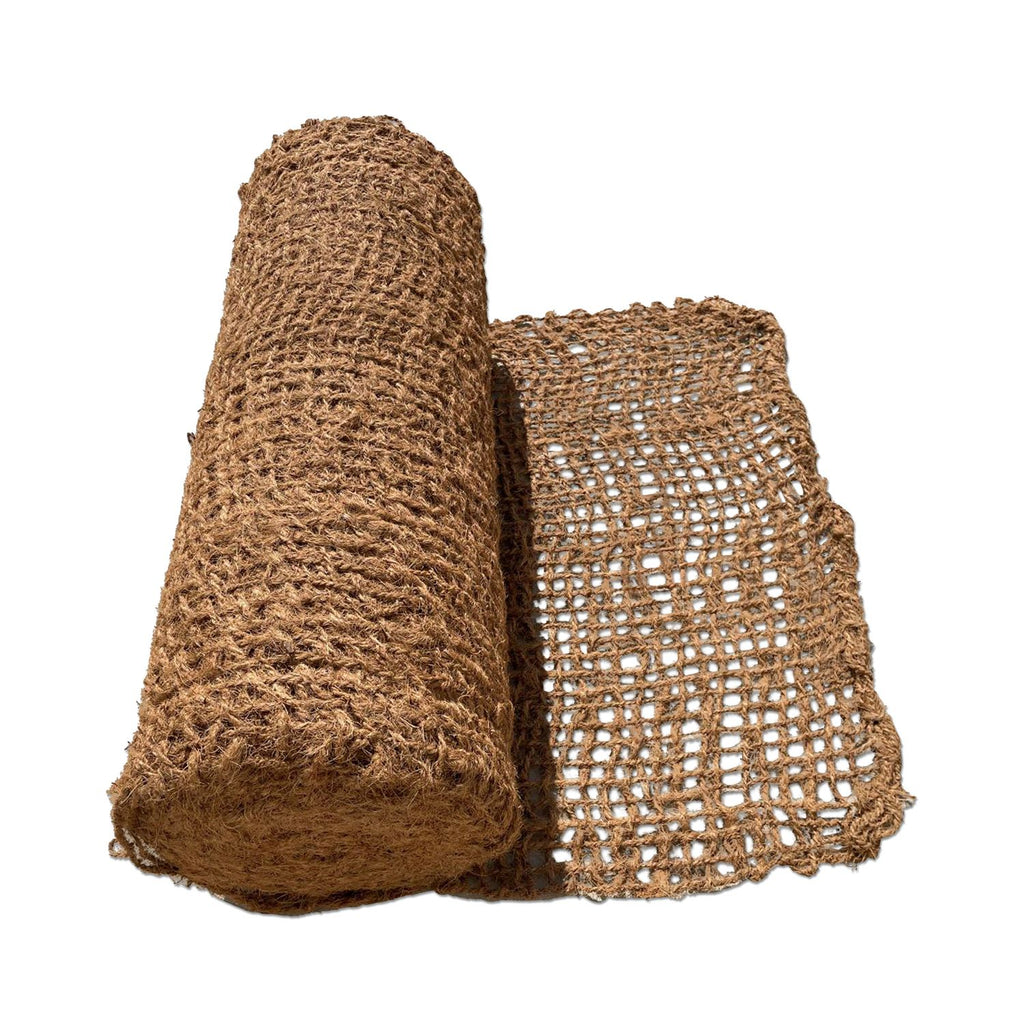
Carve supplies raw brown coir fibre in bales to companies that manufacture erosion-control blankets, coir logs and wattles, and needle-punched coir geotextiles. The fibre is decorticated from mature dry coconut husk in Paraipaba, Ceará, Brazil, and shipped FOB from the Port of Pecém. We sell fibre to manufacturers, not finished blankets or logs.[1]
| Product you make | What the fibre does | Carve grade |
|---|---|---|
| Erosion-control blankets (stitched or needle-punched coir, straw-coir) | Tensile strength and slow decomposition while vegetation establishes | Natural |
| Coir logs and wattles | Filling fibre inside the netting | Natural |
| Needle-punched geotextiles and felts | Fibre web for carding and needling | Natural |
| Vegetated mats and pre-grown slope mats | Carrier for seed and growing medium | Natural or Washed |
02 · Why brown fibre from mature husk.
- Lignin 35–45 %. High lignin gives coir its resistance to decomposition, which is why blankets and logs last on the slope while plants root.[1]
- Length 10–40 cm, loose, not combed. Fibre of natural length, ready for the manufacturer's own opening, carding and needling.[1]
- Dry mature husk, never retted in brackish water. Brown fibre from mature coconuts is thick and strong; white fibre from green husks goes to yarn and rope.[2]
- EC does not matter here. Salt content matters for growing media, not for a blanket on a slope; the Natural grade is the right one.
- Brazilian practice. Brazil's federal highway standard DNIT 074/2006 provides for coir fibre biomats to protect highway slopes.[3]
03 · The specification manufacturers ask for.
Blanket and log makers usually specify fibre class, length, moisture, impurities (pith and dust), bale weight and loading. Carve's values:
| Parameter | Carve coir fibre | Note |
|---|---|---|
| Fibre class | Brown coir fibre, mixed/mattress type | Loose, unsorted by length. Not bristle, not curled, not twisted |
| Raw material | Mesocarp fibre of the mature dry coconut husk (Cocos nucifera L.) | Dry mature husk, never retted in brackish water |
| Process | Decorticated mechanically; fibre retained on a rotary screen, ~4.1 mm mesh | Not combed. No chemicals, no additives |
| Length | 10–40 cm | Natural length, uncut |
| Moisture | ≤ 18 % | Measured per lot (mass before and after drying) |
| Impurities (pith and dust) | Impurity limit agreed per contract; lot data on request | Pith and dust content |
| Loose bulk density | ~55–80 kg/m³ | Actual value per lot |
| Lignin | 35–45 % | Literature value for coir fibre |
| Colour | Brown | Fibre from mature husk |
| EC and pH (1:5) | Measured per lot | Relevant only when the fibre goes into growing media |
| Grades | Natural · Washed · Buffered | Natural is the usual grade for industrial use |
| Bale | Pressed bales of loose fibre. Export bales: 100–130 kg, specification on request | Bale weights listed per lot on the packing list |
| Container loading | Floor-loaded 40' HC, no pallets | Net tonnes per container confirmed with the export bale specification |
| HS code | 5305.00 (Brazil NCM 5305.00.90) | Coir, raw or processed but not spun |
| Origin | Paraipaba, Ceará, Brazil | Shipped from the Port of Pecém |
Full sheet with test methods: Coir fibre specification.
04 · Logistics to North America and Europe.
Pecém is on weekly direct services to the US East Coast and Europe.[4] The transit times below are port to port.
| Destination port | Transit from Pecém | Status | Source |
|---|---|---|---|
| New York, US East Coast | As little as 6 days | Published by the terminal | APM Terminals Pecém, shipping lines page |
| Algeciras, Spain | As little as 6 days | Published by the terminal | APM Terminals Pecém, shipping lines page |
| Newark, US East Coast | 8–9 days | Indicative | Carve US import guide (APM Terminals Pecém; iContainers) |
| Savannah / Miami, US | 10–14 days | Indicative | Carve US import guide |
| Halifax, Canada | 12–16 days | Indicative | Carve Canada import guide (shipping line schedules) |
| Montreal, Canada | 14–18 days | Indicative | Carve Canada import guide |
| Rotterdam, Netherlands | ≈ 2 weeks | Indicative | Carve import page (DatamarNews, FluentCargo) |
Transit is port to port, before customs at destination. Only the six-day figures are published by the terminal operator (APM Terminals Pecém). The other figures are indicative ranges from carrier schedules summarised in Carve's import guides; the carrier's booking confirms the actual sailing. Where no reliable figure exists, the table says so.
Duties. Import duties on HS 5305 depend on the destination and change with trade policy. Check the current rate for Brazilian-origin coir fibre with your customs broker before ordering. Terms, documents and all ports in the Americas are on Coir fibre for buyers in the Americas.
05 · How a first order works.
- Sample: loose fibre from a production lot, sent by courier with its lot report.
- Specification: fibre class, length, moisture, impurity limit and export bale (100–130 kg) agreed in writing.
- Offer: FOB Pecém per 40' HC; CFR on request through our forwarder.
- Shipment: floor-loaded bales, packing list with bale weights, lot report and QR code on every bale.
06 · Frequently asked questions.
Does Carve sell finished erosion-control blankets or coir logs?
No. Carve sells the raw material: loose brown coir fibre in pressed bales, to companies that make blankets, logs, wattles and needle-punched geotextiles. The finished product is made by the manufacturer.
Which grade suits erosion-control products?
The Natural grade. Electrical conductivity does not matter in a blanket or a log, so washing adds cost without benefit. Washed and Buffered grades are for growing media.
Why brown fibre from mature husk?
Brown fibre from mature husk has a high lignin content, 35 to 45 %, which slows decomposition on the slope while vegetation establishes. Carve fibre runs 10 to 40 cm, loose and not combed, ready for carding and needling.
How long does fibre take to reach the US East Coast?
APM Terminals Pecém publishes transit of as little as six days to New York. Carve's US import guide gives 8 to 9 days to Newark and 10 to 14 days to Savannah or Miami as indicative ranges.
What about import duties?
Duties on HS 5305 depend on the destination and change with trade policy. Check the current rate for Brazilian-origin coir fibre with your customs broker before ordering.
07 · Sources.
- Carve public data sheet, Coir Fiber: length 10–40 cm, moisture ≤18 %, lignin 35–45 % (literature value), raw uncombed fibre, pressed bales.
- Wikipedia, "Coir": brown fibre from mature husks, white fibre from green husks. en.wikipedia.org/wiki/Coir.
- DNIT, Standard 074/2006-ES: biomats for protection of highway slopes (Brazil).
- APM Terminals Pecém: shipping lines and services; "as little as six days" to New York and Algeciras.