01 · Market overview: USD 300 million and growing.
The US growing media market was valued at USD 2.4 billion in 2025, projected to reach USD 3.8 billion by 2033 at a CAGR of 6.1 %.[1] Peat moss remains dominant at USD 545 million in 2025, but coir is the fastest-growing organic substrate segment.[2] North America accounts for approximately 20 % of global coir demand, roughly USD 83 to 94 million under the narrow definition. Under a broader classification that includes all coir substrate products, the US coir market is valued at approximately USD 300 million in 2025, expected to grow to USD 450 million by 2033 at a CAGR of 5.2 %.[3]
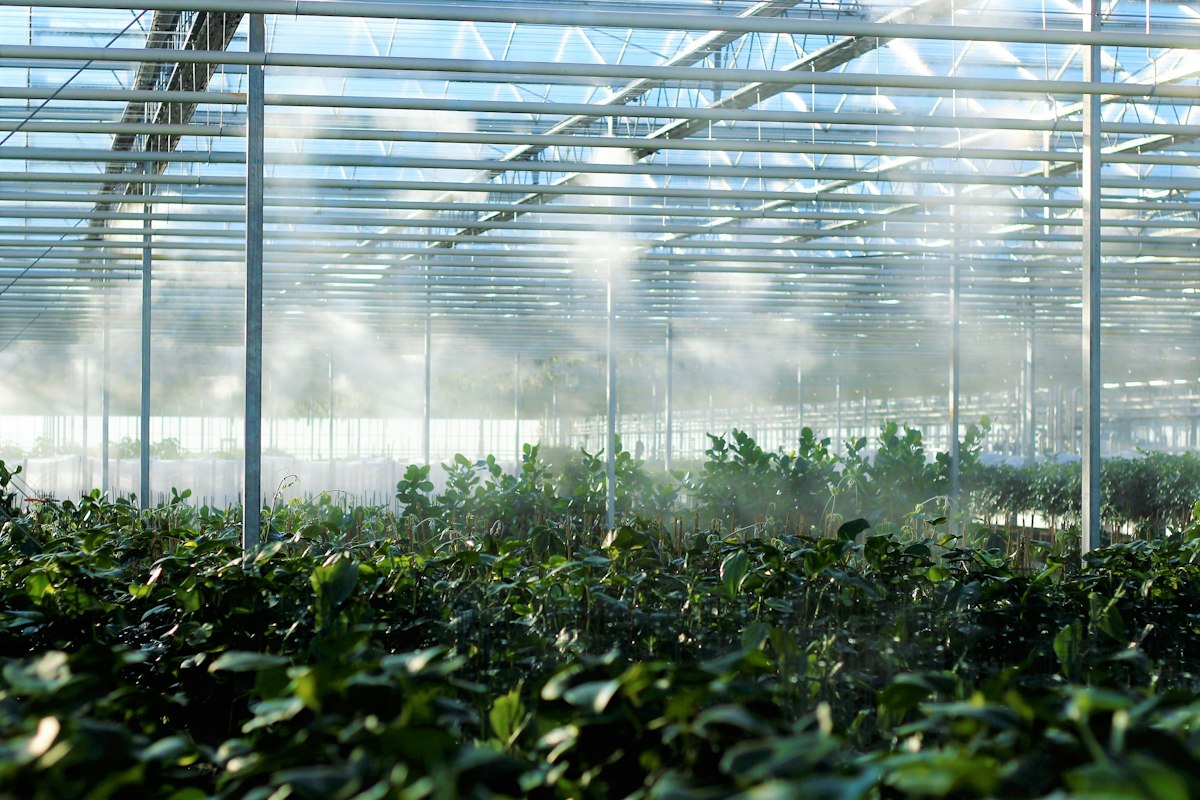
US covered greenhouse production area reached 1.04 billion square feet (96.6 million m², approximately 25,700 acres) in 2025, up from 969 million ft² in 2024. The number of floriculture producers totaled 11,728, and total floriculture crop sales reached USD 8.41 billion, up 25 % from 2024.[4] The US greenhouse produce sector reached USD 3.2 billion in 2025, with greenhouses accounting for 25 % of US specialty crop output. Over 45,000 commercial greenhouse farms in the US use coconut coir substrates.[5]
Controlled environment agriculture
The North American commercial greenhouse market was valued at USD 7.65 billion in 2025, projected to reach USD 8.25 billion in 2026 at a CAGR of 7.8 %.[6] The broader US CEA market (greenhouses, vertical farms and indoor operations) is growing at 14 to 18.1 % CAGR. CEA expansion is a primary driver of coir substrate demand as operations switch from peat-based to coir-based systems.
02 · Import volumes and supply origins.
The United States is the world's largest coir importer, accounting for 39 to 48 % of global coconut coir trade depending on HS code classification. The broader US coir product import volume exceeds 650,000 metric tons annually across all coir categories (fiber, pith, chips, mats).[8]
| Origin | Share of shipments | Notes | Source |
|---|---|---|---|
| India | 58–82 % | Dominant supplier across all categories; at least 47 exporters serve 66 US buyers | Volza |
| Sri Lanka | 11–21 % | Second-largest supplier; strong in grow bags and professional-grade substrate | Volza |
| Vietnam | 3–42 % | Surged to top fiber exporter to the US with 3,222 shipments; US$ 82 million in first 7 months of 2025 | Produce Report |
| Mexico | Emerging | Proximity advantage: containers by rail or truck; producers in Colima supply own greenhouse sector | Floral Daily |
| China | ~9 % | 58 shipments; smaller supplier | Volza |
Shipment share varies by HS code and product category. Vietnam leads in coir fiber; India leads in coir pith.
Coir prices surged 60 to 70 % compared to January 2024, squeezing margins but not slowing adoption. The long-term US coir market CAGR is 5.2 % through 2033. Short-term fluctuations reflect price spikes, tariff uncertainty and inventory destocking rather than structural demand decline.[3]
03 · Buyer segments: greenhouses, cannabis, nursery, retail.
Greenhouse vegetables
Commercial greenhouse tomato, pepper, cucumber and strawberry operations are the largest professional buyers of coir substrate. Coir slabs and grow bags replaced rockwool in many facilities because coir is more efficient, less expensive to dispose of and the spent material goes to compost. The US horticulture sector consumes approximately 60 % of imported coir.[3] A single facility in Santa Maria, California, grows tomatoes and cucumbers on coir substrate across 46 hectares (114 acres) in Ultra-Clima greenhouses, making it the largest single-site greenhouse vegetable facility in the US at 168 acres total.[9]
Cannabis and hemp
Coco coir is one of the most popular growing media for both commercial cannabis facilities and home grow operations. It is difficult to overwater, the particle structure aerates the root zone well and it is renewable. The US legal cannabis market generated approximately USD 33.8 billion in retail sales in 2025.[10] Coir is commonly used across all major legal markets: California, Colorado, Oregon, Michigan and Massachusetts. One major hydroponic retailer reports that its coco coir products constitute over 30 % of cultivation revenue, targeting 35 %.[11]
| Parameter | Cannabis specification | Source |
|---|---|---|
| Raw substrate EC | < 0.5 mS/cm | Coco For Cannabis |
| Nutrient solution, vegetative | 1.3–1.7 EC | Sensi Seeds |
| Nutrient solution, flowering | 1.5–2.0 EC | Sensi Seeds |
| pH range | 5.5–6.5 (optimal 5.5–6.0) | Industry standard |
| Grow bag sizes | 3-gallon (SOG) and 5-gallon (full cycle) | Harris Seeds |
| Pith:chip ratio | 70:30 typical | Industry standard |
Nursery and floriculture
The US floriculture sector totals 11,728 producers with USD 8.41 billion in crop sales.[4] Coir pith is used in propagation media, container mixes and soil amendments. Nurseries typically accept EC below 1.0 mS/cm for general use and below 0.5 mS/cm for seed starting.
Retail garden
The large home improvement chains carry dedicated coir categories. Retail prices for 5 kg (11 lb) compressed blocks range from USD 12.74 to 25.00. Consumer bricks (650 g) sell at USD 15 to 20 for a 5-pack. The online channel, led by Amazon, has dozens of brands with several thousand monthly unit sales for top SKUs.[12] Category range at retail runs USD 6.98 to 44.99.
04 · Regional greenhouse clusters.
| Operation | Location | Size | Coir confirmed |
|---|---|---|---|
| Large single-site greenhouse (Santa Maria) | California | 168 acres (46 ha on coir) | Yes, confirmed |
| Major greenhouse vegetable facility | Delta, Ohio | 175 acres (building) | Likely (sector norm) |
| Largest single-build greenhouse (Oneida) | New York | 64 acres / 2.78 M ft² | Likely (sector norm) |
| Multi-site greenhouse operation | Kentucky (4 sites) | 165 acres total | Likely (sector norm) |
| Urban rooftop greenhouse network | NY, IL, TX | 38 M ft² | Likely (sector norm) |
Michigan has 50.4 million ft² of greenhouse production space. Multiple additional locations operate across Texas and Utah.
05 · Logistics from Brazil: 8 to 18 days to the East Coast.
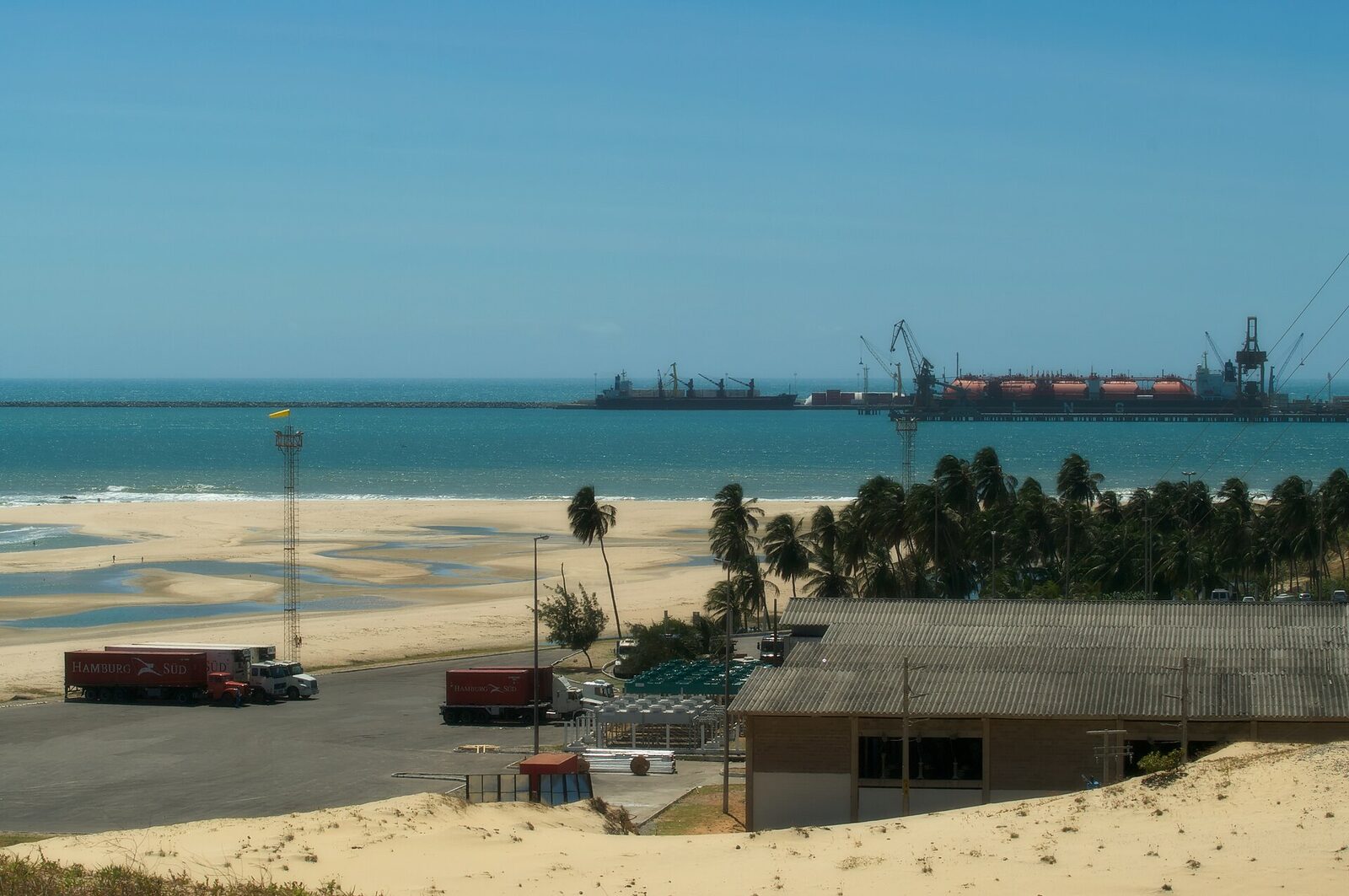
The Port of Pecem in Ceara, Brazil, is 90 km from Carve's processing site in Paraipaba. The geographic position of Northeast Brazil on the Atlantic places it closer to the US East Coast than any Asian coir origin.
| Route | Transit time | Source |
|---|---|---|
| Pecem to Newark | 8–9 days | APM Terminals Pecem |
| Pecem to Savannah / Miami | 10–14 days | APM Terminals Pecem |
| Pecem to US East Coast (general) | 8–18 days | iContainers |
| India / Sri Lanka to US East Coast (via Suez) | 28–35 days | Industry standard |
| India / Sri Lanka to US East Coast (via Cape) | 35–45 days | Industry standard |
East Coast ports
New York / New Jersey is the largest East Coast container complex and has direct Pecem service (Hapag-Lloyd). Savannah, Georgia is the third-largest US container port and the primary agricultural commodity gateway with CSX and Norfolk Southern intermodal connections to the Southeast and Midwest. Miami handles efficient agricultural product handling as a Latin American and Caribbean gateway. All three have USDA-CBP inspection facilities for agricultural imports.[13]
Container freight rates
| Route | 40 ft container rate (2026 est.) | Source |
|---|---|---|
| Asia to US East Coast | USD 2,800–5,000 / FEU (down 30–35 % from 2025 peaks) | SeaRates |
| Colombo to US (indicative) | USD 3,050 / 20 ft · USD 3,350 / 40 ft | Suaid Global |
| Brazil to US East Coast | Lower (shorter route, established trade lanes) — quote-based | Industry |
Pecem's geographic advantage translates to lower freight costs per container versus South Asian origins.
USDA APHIS import rules
APHIS regulates plant and plant product imports through 7 CFR 319. Dried, processed coconut coir (pith, fiber, chips) that is free of pests and soil is typically admissible. A phytosanitary certificate from the exporting country's NPPO (Brazil: MAPA) is standard practice. Heat treatment or methyl bromide fumigation may be required if pests of concern are detected.[14]
06 · Pricing: wholesale and retail.
Retail prices
| Product | Price (USD) | Source |
|---|---|---|
| 5 kg (11 lb) compressed block | $12.74–$25.00 | Amazon, eBay, specialty stores |
| 650 g consumer bricks (5-pack) | ~$15–$20 | Amazon (OMRI-listed brands) |
| 650 g bricks (10-pack) | $17.33 | Lowe's |
| 2.5 cu ft block | $17.75–$36.48 | Home Depot |
| 1.75 cu ft loose bag, premium | ~$20–$30 | Hydroponic retailers |
| 8 qt organic coir, consumer | ~$7–$10 | Walmart, Amazon |
Wholesale and bulk
US pallet standard: approximately 190 to 220 five-kilogram blocks per pallet (1,000 to 1,100 kg per pallet). Published wholesale examples: triple-washed 5 kg coco blocks at USD 1,149 per pallet of 190 (approximately USD 6.05 per block) and coco husk chip blocks at USD 899 per pallet of 190 (approximately USD 4.73 per block).[15] Industry estimates place bulk CIF US port at USD 200 to 400 per ton for raw coir pith depending on quality and processing level.
07 · Specifications and certifications expected by US buyers.
There are no official USDA or government grades for coconut coir. Quality is buyer-driven. The parameters US buyers specify:
| Parameter | Professional target | Retail acceptable |
|---|---|---|
| EC (1:5 extract) | < 0.5 mS/cm | < 1.0 mS/cm |
| pH | 5.5–6.5 | 5.5–6.5 |
| Contamination | No pathogens, weed seeds, heavy metals | Same |
| Calcium buffering | Required | Preferred |
| OMRI listing | Increasingly expected | Expected |
| RHP certification | Premium segment | Not required |
| Consistency | Uniform particle size, expansion ratio, moisture | Same |
| Traceability | Farm-level sourcing preferred | Not required |
Under USDA NOP (7 CFR Part 205), coconut coir is classified as a nonsynthetic material, allowed by default for organic production. OMRI-Listed products streamline certification.[17]
Carve supplies all three grades — Natural, Washed and Buffered — from Brazilian dry husk that is not retted. Specifications, EC reports and product details are on the coir pith, coir fiber and husk chips pages.
08 · Frequently asked questions.
How big is the US coir market?
The US coir market was valued at approximately USD 300 million in 2025, expected to reach USD 450 million by 2033 at a CAGR of 5.2 %. The broader US growing media market was valued at USD 2.4 billion. Coir is the fastest-growing organic substrate segment, behind peat moss at USD 545 million. Sources: Verified Market Reports, Market Data Forecast.
How much coir does the United States import?
The US is the world's largest coir importer, accounting for 39 to 48 percent of global trade. Broader US coir product imports exceed 650,000 metric tons annually across all categories. India supplies 58 to 82 percent, Sri Lanka 11 to 21 percent and Vietnam 3 to 42 percent depending on product category. Sources: Volza, IMARC Group.
What is the transit time from Brazil to the US East Coast?
From Pecem, Brazil, to Newark the transit is 8 to 9 days on Hapag-Lloyd regular service. To Savannah or Miami, 10 to 14 days. From India and Sri Lanka to the US East Coast: 28 to 35 days via Suez and 35 to 45 days via the Cape of Good Hope. Brazil delivers 2 to 4 times faster. Sources: APM Terminals Pecem, iContainers.
Which US industries use coir substrates?
The four largest segments are greenhouse vegetable production (tomatoes, peppers, cucumbers on coir slabs), cannabis cultivation (one of the most popular growing media for indoor cannabis), nursery and floriculture (11,728 producers, USD 8.41 billion in sales) and retail garden (Home Depot, Lowe's, Amazon). Over 45,000 commercial greenhouse farms use coir. Sources: USDA NASS, Econ Market Research.
What certifications do US coir buyers require?
Professional buyers require EC below 0.5 mS/cm, pH 5.5 to 6.5, calcium buffering and freedom from contamination. OMRI listing is increasingly expected even by non-organic growers. RHP certification (Dutch standard) is required by the premium segment. No official USDA grades exist for coir; quality is buyer-driven. Sources: HORIBA, OMRI, industry.
What are US wholesale prices for coir?
Wholesale: approximately USD 6.05 per 5 kg block on pallets of 190 (USD 1,149 per pallet). Husk chips: approximately USD 4.73 per block (USD 899 per pallet). Bulk CIF US port is estimated at USD 200 to 400 per ton. Retail: 5 kg blocks from USD 12.74 to 25.00. Prices surged 60 to 70 percent compared to January 2024. Sources: industry pricing, Greenhouse Grower.
MARKET INTELLIGENCE BY REGION
Coir markets we cover
Sourced market data and import guides for the destinations we serve from Pecém, Brazil.
For the worldwide picture, see our Global Coir Market overview.
09 · Sources.
- Verified Market Reports, Growing Medium Market, 2025 — verifiedmarketreports.com.
- Market Research Future, US Peat Market, 2025 — marketresearchfuture.com.
- Verified Market Reports, Coco Coir Market; Market Data Forecast, Coco Coir Market, 2025 — marketdataforecast.com; Greenhouse Grower, "The Growing Media Market: Tariffs, Trends, and What Lies Ahead" — greenhousegrower.com.
- USDA NASS, 2024 Census of Horticultural Specialties — nass.usda.gov; RFD TV, "Floriculture Sales Climb as Greenhouse Production Area Expands" — rfdtv.com.
- Econ Market Research, Coconut Coir Market — econmarketresearch.com.
- Market Data Forecast, North America Commercial Greenhouse Market — marketdataforecast.com; GM Insights, CEA Market — gminsights.com.
- USDA ERS, Organic Agriculture — ers.usda.gov; Organic Produce Network — organicproducenetwork.com.
- Volza, Coconut Coir Imports in US — volza.com; IMARC Group, Coco Coir Market — imarcgroup.com.
- HortiDaily, greenhouse vegetable production on coir substrate — hortidaily.com.
- Advanced Nutrients, Guide to Growing Cannabis in Coco Coir — advancednutrients.com; Cannabis Promotions, Statistics 2026 — cannabispromotions.com.
- SEC Filing, GrowGeneration acquisition, 2021; GrowGeneration earnings, Feb 2025.
- Home Depot, Coco Coir category — homedepot.com; Lowe's, Coconut Coir category — lowes.com; Amazon, coco coir search.
- US Container Ports — wikipedia.org; APM Terminals Pecem — apmterminals.com.
- USDA APHIS, How To Import Plants — aphis.usda.gov; APHIS, Phytosanitary Treatments — aphis.usda.gov.
- Industry pricing; Coir America Products — coiramerica.com.
- Farmer's Almanac, Peat Alternatives — farmersalmanac.com.
- OMRI (Organic Materials Review Institute) — omri.org; USDA NOP, 7 CFR Part 205 — ams.usda.gov.
- HORIBA, pH and Conductivity in Coconut Coir — horiba.com.
- Produce Report, US largest market for Vietnamese coconuts — producereport.com.
- IndexBox, Coir-Based Growing Mixes — indexbox.io.
- SeaRates, Container Costs 2026 — searates.com; Suaid Global, FCL Rates 2026 — suaidglobal.com.
- iContainers, Brazil to US — icontainers.com.
- Greenhouse Grower, NatureFresh Farms 175-Acre Ohio — greenhousegrower.com.
- Floral Daily, North American coir demand — floraldaily.com.